AI時代の知的財産権検討会 第11回
2026-04-21一次資料(出典)
議事録・配布資料の全文(政府公表資料より。要約でなく原文に基づく参照用)。
議事録
2026-4-21
AI時代の知的財産権検討会(第11回)
10時00分~12時00分
○福田参事官
定刻となりましたので、会議を開催させていただきます。
傍聴される方々におかれましては、会議の様子のスクリーンショットや録音・録画は御
遠慮くださいますようにお願いいたします。
本 日は 、 中原 委員 が 欠席 、竹 中 委員 、福 井 委員 が 10 時 30分 まで の 御参 加と な って おり
ます。
本検討会は、渡部俊也委員に座長をお願いしておりますので、ここからの議事の進行を
渡部座長にお願いいたします。
○渡 部座 長
た だい ま から 、第 11 回「 AI時 代 の知 的財 産 権検 討会 」 を開 催い た しま す。
本日は、御多忙のところ、御参集いただきまして誠にありがとうございます。
初めに、事務局から本日の会議資料の確認をお願いいたします。
○福田参事官
本日の配付資料は、資料1「パブリックコメントで寄せられた主な意見」、
資料2「一般社団法人日本新聞協会提出資料」、資料3「一般社団法人コンテンツ海外流
通促進機構提出資料」、資料4「ビジネス・ソフトウェア・アライアンス提出資料」、資
料 5 「 一 般 社 団 法 人 日 本 知 的 財 産 協 会 提 出 資 料 」 の ほ か 、 参 考 資 料 1 - 1 「 プ リ ン シプ
ル・コード(仮称)(案)【日本語版】」、参考資料1-2「プリンシプル・コード(仮
称)(案)【英語版】」、参考資料2-1「プリンシプル・コード(仮称)(案)概要開
示対象事項
具体例【日本語版】、参考資料2-2「プリンシプル・コード(仮称)(案)
概要開示対象事項
具体例【英語版】」を配付しております。
以上です。
○渡部座長
ありがとうございました。
それでは、本日の議事に入ります。
最初に、前回検討会の開催以降の経過及び資料1について、事務局より説明をお願いし
ます
○福田参事官
それでは、御説明いたします。
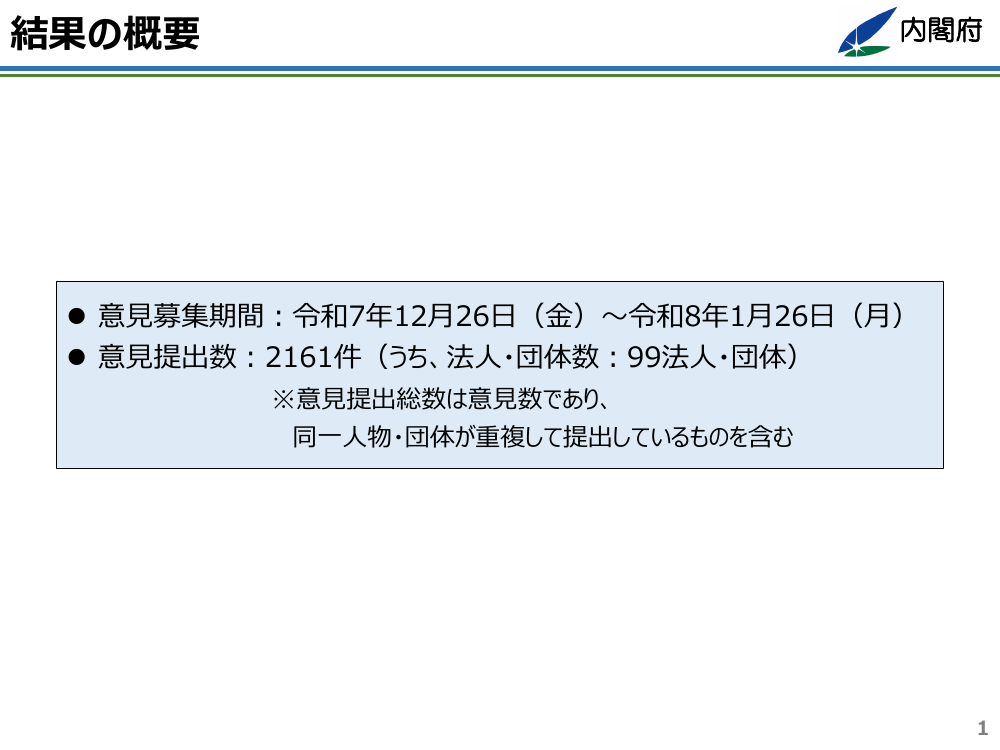
資料1の1ページを御覧ください。既に御案内のとおり、事務局において、コード(案)
の 本 文 及 び 概 要 開 示 対 象 事 項 の 具 体 例 に つ い て 、 日 本 語 版 及 び 英 語 版 を 作 成 の 上 、 昨年
12月26日から本年1月26日までパブリックコメントを行ったところです。
その結果、2,161件の御意見をいただき、うち法人・団体として登録いただいた件数は
99 件ご ざ い ま した 。 こ の 数字 に つ き まし て は 、 同一 の 組 織 が重 複 し て 提出 し て い るも の
を含んでおります。改めて、大変多くのコメントをいただき、感謝申し上げます。
本日配付した資料は、コメントのうち主な意見として考えられるものを事務局で編集・
作成したものです。したがいまして、いただいたコメントをそのまま御紹介するものでは
なく、その趣旨が明確になるよう記載を絞った内容となっておりますので、関係する意見
1
を提出いただいた皆様におかれましてはあらかじめ御了承いただければ幸いです。
本日の資料では、いただいた御意見に対する事務局としての考え方をお示ししてはおら
ず、また、パブリックコメントの対象であるコード(案)の修正についても特段資料は作
成 して お り ま せん 。 本 日 及び 23 日 の ヒア リ ン グ を踏 ま え 、 改め て 事 務 局に お い て 資料 を
作成することとしております。
それでは、主な意見について、全て読み上げますと時間を要することから、ページごと
に2~3の意見を御紹介いたします。
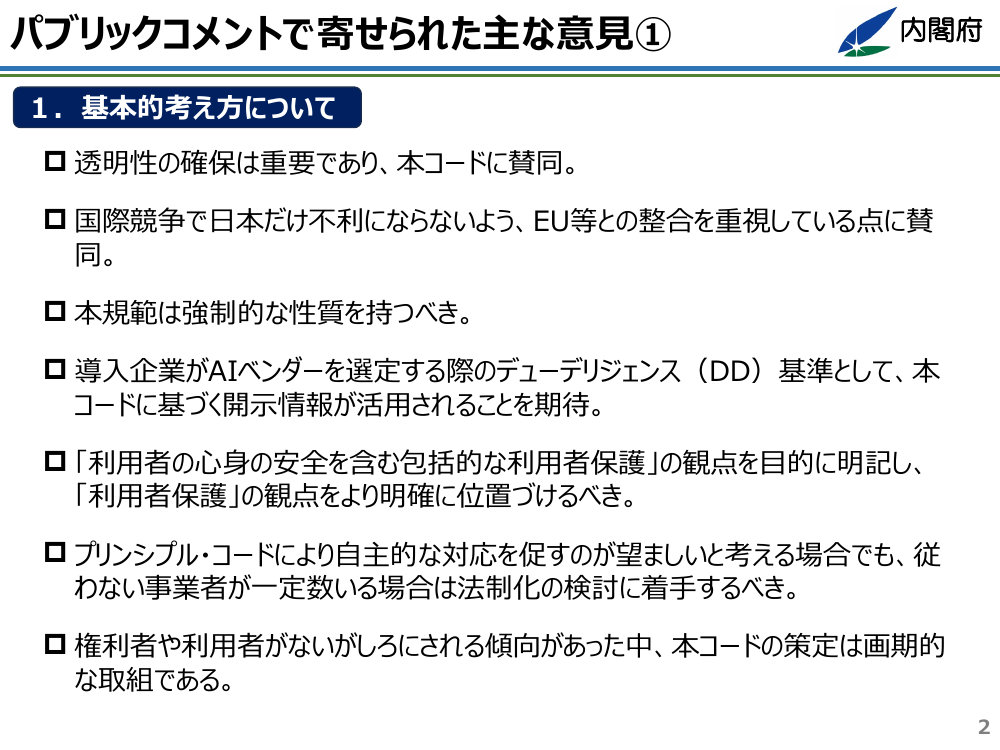
初めに、基本的考え方について、2ページでは、透明性の確保は重要であり、本コード
に賛 同。 導 入企 業が AI ベン ダー を 選定 する 際 のデ ュー デ リジ ェン ス (DD )基 準 とし て、
本コードに基づく開示情報が活用されることを期待。権利者や利用者がないがしろにされ
る傾向があった中、本コードの策定は画期的な取組である。
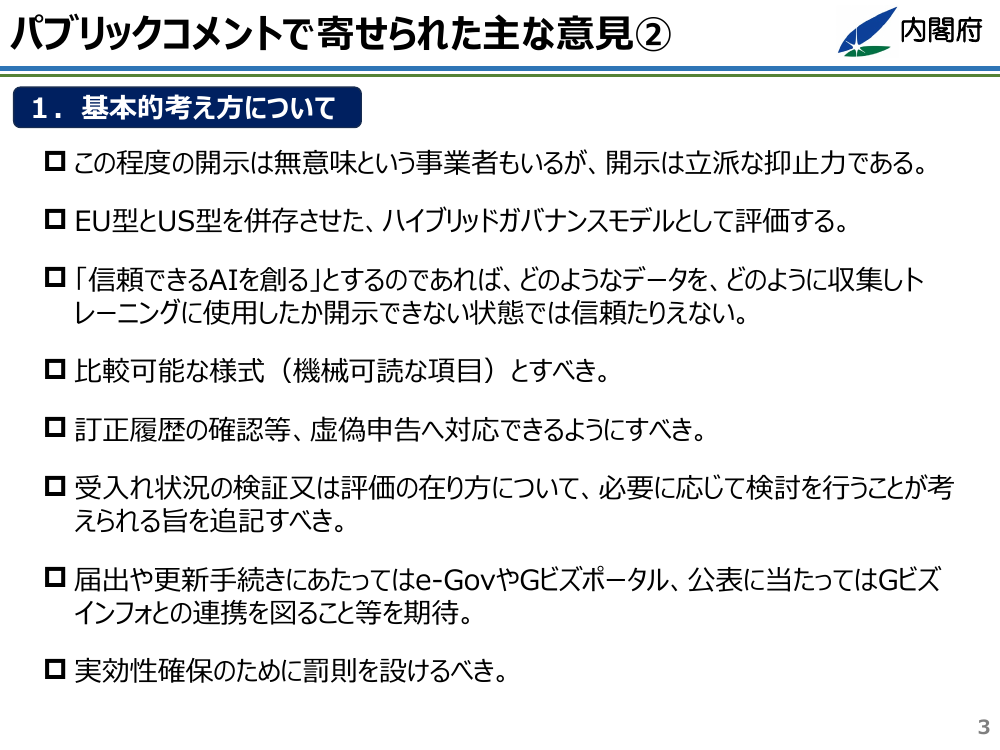
3ページでは、この程度の開示は無意味という事業者もいるが、開示は立派な抑止力で
ある。比較可能な様式(機械可読な項目)とすべき。受入状況の検証または評価の在り方
について、必要に応じて検討を行うことが考えられる旨を追記すべき。
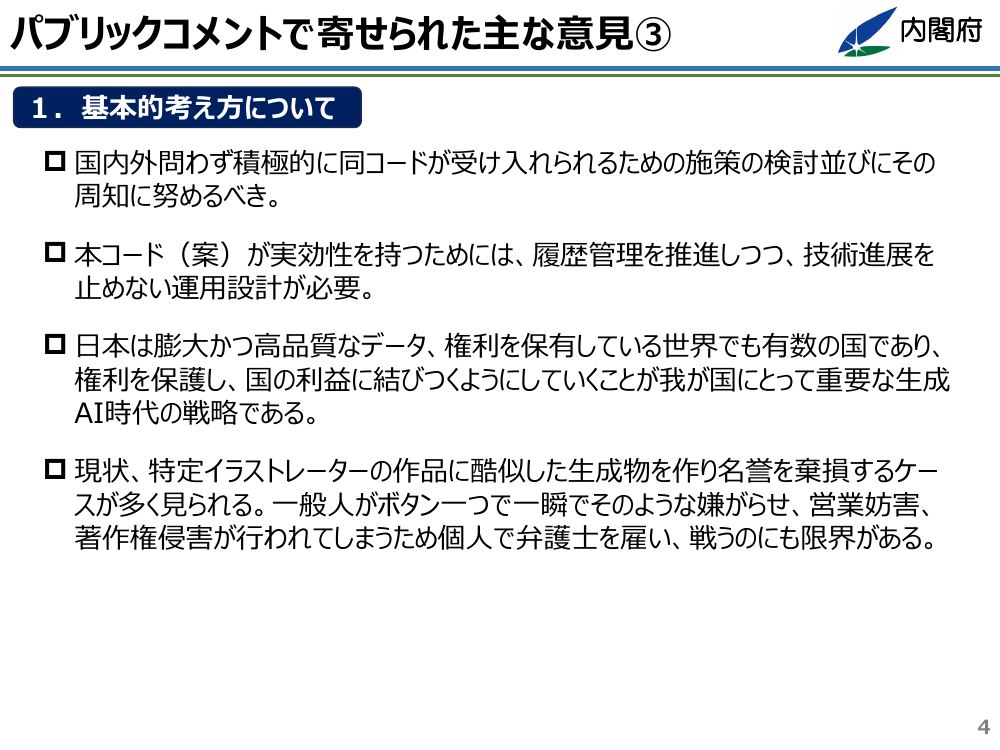
4ページでは、国内外問わず積極的に同コードが受け入れられるための施策の検討並び
にその周知に努めるべき。本コード(案)が実効性を持つためには、履歴管理を推進しつ
つ、技術進展を止めない運用設計が必要。
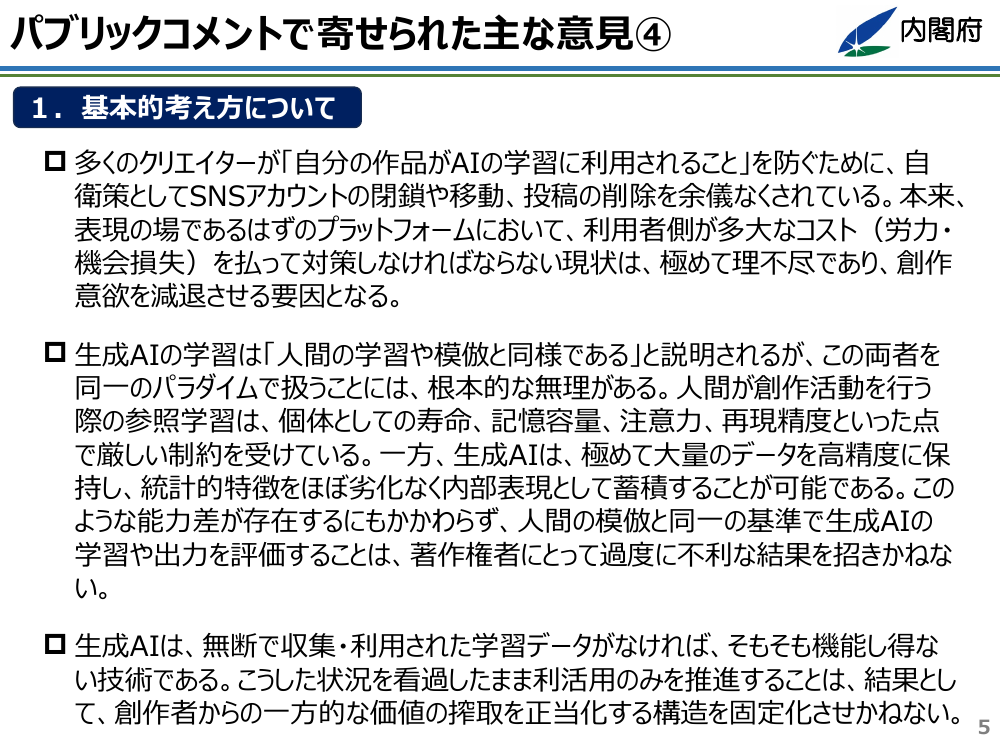
5ペ ー ジ で は、 多 く の クリ エ ー タ ーが 「 自 分 の作 品 が AI の学 習 に 利 用さ れ る こ と」 を
防ぐために、自衛策としてSNSアカウントの閉鎖や移動、投稿の削除を余儀なくされてい
る 。 本 来 、 表 現 の 場 で あ る は ず の プ ラ ッ ト フ ォ ー ム に お い て 、 利 用 者 側 が 多 大 な コ スト
(労力・機会損失)を払って対策しなければならない現状は、極めて理不尽であり、創作
意欲を減退させる要因となる。
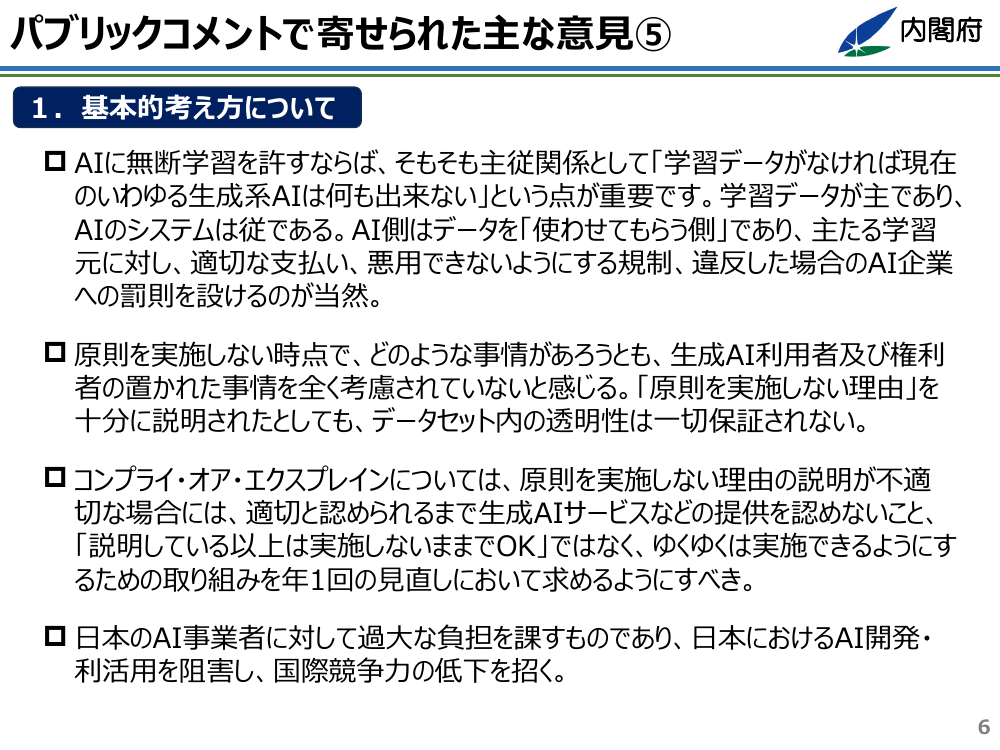
6ページでは、コンプライ・オア・エクスプレインについては、原則を実施しない理由
の 説明 が 不 適 切な 場 合 に は、 適 切 と 認め ら れ る まで 生 成 AI サー ビ ス な どの 提 供 を 認め な
い こと 、 「 説 明し て い る 以上 は 実 施 しな い ま ま でOK 」 で は なく 、 行 く 行く は 実 施 でき る
よ うに す る た めの 取 組 を 年1 回 の 見 直し に お い て求 め る よ うに す べ き 。日 本 の AI 事業 者
に 対し て 過 大 な負 担 を 課 する も の で あり 、 日 本 にお け る AI 開発 ・ 利 活 用を 阻 害 し 、国 際
競争力の低下を招く。
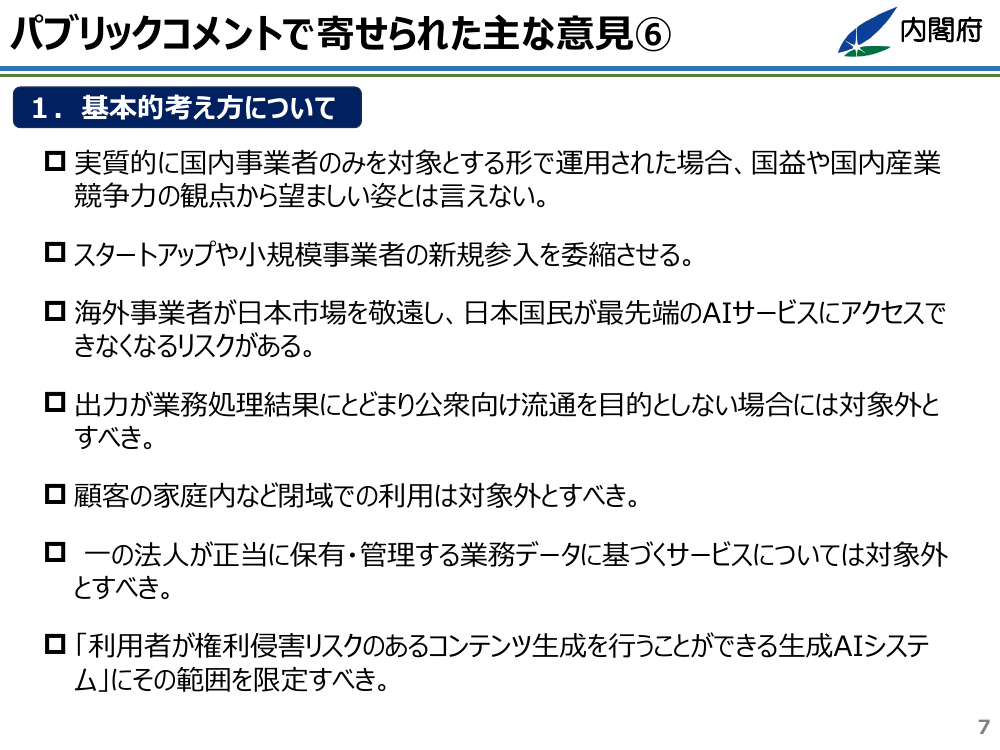
7ページでは、実質的に国内事業者のみを対象とする形で運用された場合、国益や国内
産業競争力の観点から望ましい姿とは言えない。出力が業務処理結果にとどまり公衆向け
流通を目的としない場合には対象外とすべき。一の法人が正当に保有・管理する業務デー
タに基づくサービスについては対象外とすべき。
8ページでは、事業者一覧が公表されるため、事実上の強制力を持つ規制と変わらない。
コンプライ・オア・エクスプレインの手法によらない一般的なガイドラインとすべき。
9ページでは「エクスプレイン(実施しない理由の説明)」を選択する場合において、
事業競争力確保の観点から「技術的な制約」や「過度な業務負担」が正当な理由として認
2
められる旨をガイドライン等で明確化するべき。コンプライせずエクスプレインを採用し
た事業者や、エクスプレインさえしない事業者との間で不公平感を感じさせないに足る実
効性確保の具体策が示されるべき。
10ページでは、EU AI Act等の海外の枠組みと比較しても厳しい要件が含まれ、事業者
に 過剰 な 負 担 を強 い る 内 容と な っ て いる 。 AI 法 との 位 置 づ けや 附 帯 決 議と の 内 容 との 整
合を考慮すべき。「生成AI提供者」では開示が難しい項目があり、考慮すべき。
11ペ ー ジ で は、 リ ス ク ベー ス ア プ ロー チ を 採 用し 、 段 階 的な 負 担 と すべ き 。 「 エク ス
プレイン」として非開示の理由を公表したとしても、風評被害等で事業者が不利益を被る
ことも想定される。
次に 、 原 則 1に つ い て 、12 ペ ー ジ では 、 概 要 レベ ル で の 情報 開 示 は 国際 的 な ベ スト プ
ラクティスとも整合している。内閣府に公開いただいた記載例に沿った粒度であれば対応
可能なものが多い。具体例が示されることで分かりやすくなり、事業者の取組を比較でき
るようになるので、よい取組である。
13ペ ー ジ で は、 実 際 は 外国 で も デ ータ セ ッ ト の透 明 化 が 進ん で お り 、日 本 が 遅 れな い
ようにすべき。ユーザーエージェント公開、変更通知、クロール方針の履歴までセットで
記載すべき。
14ペ ー ジ で は「 原 則 1 」が 定 め る 開示 対 象 は 「デ ー タ に 関連 す る 事 項」 と の 曖 昧な 表
現にとどまり、また、開示の具体例もデータセットを特定し得る記述とはなっておらず、
実効性のある開示を求める規定とすべき。AIクローラーの名称/識別子、目的、所有者等
の情報を公表することにコミットしている点に同意する。こうした透明性は、権利者やボ
ット管理提供者がトラフィックを正確に識別・管理するために必要。
15 ペー ジ では 、権 利 者が 生成 AI の学 習や 利 用に 反対 の 意思 を示 し てい るウ ェ ブサ イト
を、無断で学習や検索拡張生成(RAG)の対象としないことを追記すべき。「知的財産権
を侵害する生成物の生成を防止する技術的措置を可能な限り講ずること」を「知的財産権
を侵害する生成物の生成を防止する技術的措置を講じ、その取り組み内容を公表すること」
に修正すべき。
16ペ ー ジ で は、 最 低 限 の開 示 が 望 まれ る 情 報 につ い て は テン プ レ ー トを 設 け る など 、
事業者の負担を軽減するための対応をすべき。ルールを守る善意のユーザーを想定するの
ではなく、ルールを破る人がいることを前提に、物理的・技術的に「悪いことができない」
仕組みをAI自体に組み込むことを必須要件とすべき。
17ペ ー ジ で は、 開 示 内 容の 粒 度 や 表現 方 法 に よっ て は 、 専門 的 知 識 を有 し な い 利用 者
や個人の権利者にとって実質的な理解が困難となるおそれがある。概要開示が形式的なも
のにとどまらないよう、分かりやすさへの配慮が求められる。
18 ペ ー ジで は 、 原則 1の 開 示 は事 業 者 にと って 技 術 的・ 経 済 的に 多大 な コ スト と な る。
情報開示を行うことでノウハウの流出やセキュリティー上の懸念が生じる。どの基準まで
公開するとコンプライしたことになるのか、AI事業者側で判断を行いにくい。
3
19ペ ー ジ で は、 概 要 開 示対 象 事 項 には 、 ア ー キテ ク チ ャ ーや 設 計 仕 様、 ト レ ー ニン グ
方 法、 学 習 に 用い た デ ー タの 種 類 な ど、 AI 事 業 者に と っ て 営業 秘 密 や ノウ ハ ウ と 言え る
部分も含まれており、競争力の根幹に関わるものである。クローラーの識別子を公表する
と、ウェブサイトの運営者は誰がどのようなデータを取得したのかを把握することができ
るため、かかる情報が運営者により広く公開される等により流出すると、守秘性の高い情
報が流出してしまう。
20ペ ー ジ で は、 意 思 決 定に 関 わ る 決裁 書 類 や 顧客 と の 議 事録 等 は 、 事業 者 の 営 業秘 密
に該当するとなることがほとんどであり、開示は現実的に極めて困難。電子透かしや
C2PA とい っ た技 術 はま だ十 分 に浸 透 した 技 術 では な く発 展 途上 で あ り、 容 易に 削 除し 得
るもので、実効性も十分とは言えないため、この項目は削除すべき。
21ペ ー ジ で は、 意 思 決 定等 の 全 て を追 跡 ・ 遡 及可 能 な 状 態と す る こ とは 、 事 業 者の 負
担 及 び 機 密 保 持 の 観 点 か ら 現 実 的 に 困 難 で あ る 。 「 ア ー キ テ ク チ ャ 」 の 開 示 は 、 例 えば
「Transformerベース」「拡散モデル」といった技術的な大分類の提示をもって原則を満
たすものとし、独自の技術的工夫や詳細な内部構造の開示を求めるものではないことを明
記するべき。
22 ペ ー ジで は 、 追加 のリ ソ ー スが 必 要 とさ れる こ と にな る 上 に効 果が 乏 し いの で 反 対。
モ デル ア ー キ テク チ ャ ー を記 載 し た とこ ろ で 、 それ が 一 般 にAI モ デ ル 学習 へ の デ ータ の
無断利用などで損害を被る人の救済にはなり得ない。保持期間は一律ではなく、用途・影
響度・事故原因究明・再発防止・立証の必要性等を踏まえたリスクベースで整理すること
が望ましい。
次に 、 原 則 2で ご ざ い ます 。 23 ペ ージ で は 、 権利 者 や 利 用者 が 「 自 分の コ ン テ ンツ が
学習対象に含まれた可能性」を確認し、必要に応じて救済につなげるための重要な導線で
ある。事業者に対しては、形式的な当該URLそのものからの学習の有無の確認にとどまら
ず、当該作品(コンテンツ)を含む動画等が学習データに含まれているか否かについて確
認・回答させるべき。
24ペ ー ジ で は、 手 数 料 や回 数 制 限 は、 弱 い 権 利者 ほ ど 不 利に な り 得 るた め 、 低 額・ 免
除基準、個人クリエーター配慮を意識すべき。「一定の手数料」や「回数制限」等の濫用
防止策について、業界標準となる具体的な目安(ひな形)を政府主導で検討すべき。
25ページでは、原則2において「訴訟提起、調停申立て、ADR(裁判外紛争解決手続)
その他の法的手続を現に行い」とあるが、法的手続は相当の準備があって初めてできるも
のであって、権利者が上記の行為を行う前段階にこそ学習データの開示が必要である。特
定のドメインがクローラーの収集対象に含まれているか、あるいは第三者から提供された
学習データソースに含まれているかを開示することを求めることは、モデルトレーニング
の実態を正確に反映していない。元の学習データはモデル内に保存されないため、特定の
出力を単一のソースURLまで追跡することは意味をなさず、技術的にも大変困難。
26ペ ー ジ で は、 情 報 収 集の 手 段 と して は 、 本 件文 書 に 記 載さ れ て い る訴 訟 提 起 後の 当
4
事 者照 会 の ほ か、 訴 え 提 起前 の 当 事 者照 会 や 、 弁護 士 法 第23 条 に 基 づ く照 会 制 度 など 、
既に複数の法的手段が整備されており、既存の証拠開示制度で足りる。権利者が訴訟提起
を 準備 し て い る場 合 に 生 成AI 事 業 者 が自 発 的 に 自ら 不 利 に なる 可 能 性 のあ る 情 報 を開 示
することはおよそ望めず、開示に応じるインセンティブがないため、実効性が疑問。
27ペ ー ジ で は、 ロ グ が 存在 し な い 場合 や 確 認 に多 額 の 費 用を 要 す る 場合 に は 不 明と の
回答を行えることを明記すべき。サービス運用をしていない上流に、実務上の問合せ対応
や説明責任が波及する懸念がある。原則2の回答主体は原則として当該サービスの提供者
であることを明記し、上流開発者や再頒布者を過度に巻き込まない線引きを入れるべき。
次に 、 原 則 3で ご ざ い ます 。 28 ペ ージ で は 、 利用 者 が 意 図せ ぬ 侵 害 を回 避 し 、 安心 し
て作品を発表するための有効な手段となり得るもの。「訴訟提起、調停申立て、ADR(裁
判外紛争解決手続)その他の法的手続に用いる目的で利用しない旨を誓約していること」
とあるが、どういった理由でこの文言があるか理解できない。海賊版、無断転載、流出し
た資料、児童ポルノ、学習禁止を明示された投稿プラットフォームからのデータ、あるい
はrobot.txtや学習阻害措置が施されたデータ等、現状でも学習に用いるべきでないと我
が国のガイドラインでも示されているようなデータが出てきても訴訟等に利用するなとい
うことか?本項目は必要ない。「求めがあり条件を満たす場合に回答を行う」とあるが、
なぜ被害者が労力を払わなければいけないのかが分からない。「求めがあった場合」でな
く、原則として常に開示すべき。
29 ペー ジ では 、 AI 生 成物 の便 益 を直 接享 受 する のは 利 用者 であ る ため 、著 作 権侵 害の
有 無等 を 確 認 する た め の 手続 コ ス ト を生 成 AI 事 業者 に 一 律 に課 す る こ とは 、 負 担 の所 在
の観点から合理性を欠く。広範に開示を認めることは、開示請求先となる企業に対し必要
以上の負担を生じさせることとなるほか、開示請求がみだりに乱発されるリスクがある。
30 ペー ジ では 、ユ ー ザー は、 自 身が AIを 利 用し て生 成 した コン テ ンツ と既 存 の著 作物
との類似性が高いと判断した段階で、依拠性を確認するまでもなく当該生成物の公開を差
し控え、または取りやめるのが通常。類似性を意識しつつも、依拠性を満たさないことを
信じて公開を実施または継続しようとするのは一部ユーザーにとどまると思われ、そのよ
うなユーザーへの対応のために独立した本原則を設ける必要性に疑問。
31ページでは、OSSライセンスの提示をもって内容の開示に代えることができるとする
本 例外 規 定 に つい て 「 例 外」 が 生 成AI 事 業 者 の 抜け 道 と な らな い よ う 実務 の 実 態 に即 し
た柔軟な運用とすべき。これは原則3が終わった次の「例外の内容について」でございま
す。それから、規約で適用除外・制限する場合には、対象範囲、理由、代替措置、第三者
への影響まで説明させるべき。
最後 、 32 ペ ージ で は 、 オー プ ン ソ ース ソ フ ト ウエ ア や 外 部基 盤 を 利 用す る 事 業 者に 対
する例外を設けているものの、その内容は限定的であり、実務上の負担軽減としては不十
分。
以上、主な意見を紹介させていただきました。最終的には、先ほど申し上げたとおり、
5
本日及び次回のヒアリングも踏まえ、主な意見に対する事務局としての考え方を作成し、
コード(案)の今度の扱いを含め、次々回以降の検討会において御審議いただきたいと考
えております。
説明は以上でございます。
○渡部座長
ありがとうございました。
ただいま説明いただいた内容について、委員の皆様から特段御質問等ございましたら受
けることができますが、よろしいでしょうか。
特になければ、進めたいと思います。
本日は、この後、資料の順番のとおり、関係団体よりヒアリングを行って、事実関係な
どについては、その都度、質疑応答の時間を設けて、その場で受けたいと思います。その
後、残りの時間、全部のヒアリングが終わった後、委員からの質疑応答という2段階で進
めたいと思います。今日は全体的に時間の管理が必要なので、全体で頭に入れて進めてい
ただければと思います。
改めまして、本日は御多忙のところ、一般社団法人日本新聞協会様、一般社団法人コン
テンツ海外流通促進機構様、ビジネス・ソフトウェア・アライアンス様、一般社団法人日
本知的財産協会様の皆様におかれましては、ヒアリングに御対応いただきまして誠にあり
がとうございます。
それでは、早速でございますけれども、日本新聞協会様より御発表をお願いできればと
思います。よろしくお願いいたします。
○日本新聞協会
提出した資料に沿って、我々の意見について説明いたします。まず、1
ページ目ですが、我々は3年にわたって報道コンテンツの保護を繰り返し訴えてまいりま
した 。昨 日 も「 AI検 索 サー ビス に 関す る声 明 」を 発表 し まし た。 こ の中 でも 、 AI検 索が
広がることによってコンテンツ保護が一層困難になっている現状について説明しています
が、本日の議題になっているプリンシプル・コードについても、より強力かつ早期に策定
することが必要だという意見を述べています。
続きまして、2ページです。本検討会でも議論になっている法・技術・契約のいずれの
解決策についても、我々は課題が存在していると考えています。法律による解決について
は、コンテンツが大量・瞬時に生成されるため、個別侵害事案の訴訟には限界があると考
えています。また、権利者側の証拠の収集について、非常に高いハードルがあって、限界
があるというのが我々の考えです。
技術面につい てです が、robots.txt による ブロックを我々 も行っ ておりますけれ ども、
無視されたり、あるいはユーザーエージェントを非開示にされていたり、ほかの事業者を
通じてデータを入手していたりする事例が確認されており、困難があると考えています。
また、契約については、我々の側から事業者の利用実態が知り得ないのが現状です。ま
た、無断収集が可能なため、事業者側に契約締結のインセンティブが生じづらいことも課
題と考えています。
6
3ページ以降は、1月に提出した当協会の意見のポイントをまとめています。3ページ
は総論部分で、プリンシプル・コード(案)について、報道コンテンツなどの知的財産の
適切な保護を一歩前進させるため、重要な内容だと受け止めています。権利者や利用者に
とって安心・安全な利用環境の確保を目指す取組について、我々は賛同しています。強制
的な開示や罰則を伴わないことについては、実効性を高めていくことが必要だと感じてい
ます。
これ ま で も 文化 庁 の 「 AIと 著 作 権 に関 す る 考 え方 に つ い て」 等 を 遵 守し て い な いこ と
が強く疑われるサービス展開が海外事業者を中心に散見されています。遵守する事業者と
の公正な競争という観点からも問題になると考えています。このため、政府はコードに従
わない事業者、とりわけ影響力の大きい海外事業者に対して周知と遵守を積極的に働きか
けるべきであり、改善が見られない場合は法制化を迅速に検討するよう求めています。
続きまして、4ページは原則1についてです。透明性確保のための措置として、学習デ
ータに関する事項が開示対象となったのは重要だと考えています。クローラーに関する開
示を求めた方針も妥当であり、第三者クローラーからの提供データを対象に含めているこ
とにも賛同しています。加えて、RAGで利用される参照用の知識データについても蓄積し
ている場合は開示対象に含めるべきだと考えています。
データ収集を専門とする業者の存在も明らかになっており、外部業者を利用したデータ
収集の場合、権利者がコンテンツを保護することが一層困難だと考えています。知識デー
タも開示対象となることを明確にすべきというのが我々の主張であります。知的財産権保
護のための原 則の策定 、ペイウォー ルなどの アクセス制限 の尊重、 robots.txt に従う ク
ローラーの採用などは重要であり、本案に賛同しています。
続きまして、5ページ目は原則2、原則3に対する意見です。コンテンツ保護のために
は、使用されたデータセットを権利者が特定できることが重要だと考えております。ぜひ
実効性のある開示を求める規定としていただきたいと考えています。
生成 AI 事 業 者に よ る 一 方的 な コ ン テン ツ 利 用 が横 行 す る 中で 、 開 示 要求 の ハ ー ドル は
極力低くすべきだというのが当協会の主張です。訴訟の準備段階で開示を求めることがで
きる内容となっていますが、準備は検討段階も含め広く解釈されるべきと考えます。原則
2では、URL情報等だけではなく、要求者が指定するコンテンツが含まれているか否かに
ついても要求可能とすべきと考えています。原則3の開示要求可能事項に関しても、こう
した趣旨を踏まえて検討していただければと要望します。
続きまして、6ページでは事業者側から示された主な懸念等に対する意見を述べていま
す。1点目、情報公開・開示をめぐる営業秘密やセキュリティーへの懸念です。今回の案
に示された公開の範囲・粒度は、我々は過剰とは考えておりません。開示情報の利用目的
も限定されております。開発者・事業者側に実害が生じる場合には説明すれば回避できる、
という設計にもなっていることに留意すべきと考えます。我々からしますと、経済的な価
値のあるコンテンツの無断利用という権利者側の実害は既に明らかになっていると考えて
7
います。クロ ーラー名 等の非公開に より robots.txtの 設定や証 拠集 めが困難にな る現状
を 踏ま え る と 、AI 法 は 透 明性 確 保 を 求め て い ま すの で 、 こ の兼 ね 合 い の中 で 検 討 され る
べきことだと考えています。
2点目に、対応するためには事業者側にコストが発生するという意見もあるようです。
開示請求のためには権利者側にもコストが発生する、ということに着目いただきたいと思
います。このコストを考えれば、何でも開示を求めることは考えにくいのではないかと思
います。透明性が高まることで契約締結につながり、そのことが双方のコスト削減につな
がる可能性があるのではないかと考えています。
3点目に、国内事業者だけ義務を負うことになるのではないかという指摘もありました。
国内・海外を問わず事業者がルールを守るべきというのは我々も同じ考えです。政府は海
外事業者に対する周知と遵守の働きかけをすることが必要だと考えています。
続きまして、7ページを御覧ください。プリンシプル・コードによって透明性が確保さ
れた場合に期待されることを、先ほどの図を使って御説明をさせていただきたいと思いま
す。課題解決に一定の道筋がつくのではないかと期待しています。
この7ページで下線を引いたところが具体的に期待されるところでありますが、法律に
よる解決という意味では、権利者側の証拠収集の助けになることが期待されます。
技術による 解決の部 分では、 robots.txtの 無視、ユーザ ーエージ ェントの非開 示、ク
ローラーの偽装といった現状が改善されるのではないかと期待しています。
また、契約による解決の部分ですが、事業者の利用実態について、事業者や権利者が情
報を共有することで契約による解決につなげることが前進すると期待しています。
最後に、8ページ、当協会の意見のまとめを記載しました。権利者にとっては課題が山
積している中で、プリンシプル・コードの策定は透明性の向上による課題解決につながり
得ると考えております。
プリンシプル・コードは、知的財産の適切な保護を一歩前進させるために重要な取組で、
AI法の基本理念の一つである透明性確保に沿う内容でもあると考えております。
原則1では 、クロー ラーの開示、 ペイウォ ール、robots.txt遵守 、知財保護の 原則策
定が重要で、原則2では、利用されたデータが特定できることや、情報開示のハードルを
下げることが必要だと考えています。
私どもの説明は以上となります。どうもありがとうございました。
○渡部座長
ありがとうございました。
事実関係の質問を受けるのですけれども、竹中委員と福井委員、今、まだ入っておられ
ますか。何かコメントございましたら、この場でいただければと思います。
○竹中委員
特にありません。
授業がありますので、先に出させていただきます。失礼します。
○渡部座長
ありがとうございます。
(竹中委員退室)
8
○渡部座長
福井委員、いかがでしょうか。
○福井委員
ありがとうございます。では、出る前に簡単なコメントだけ。
大 変 に 丁 寧 な パ ブ リ ッ ク コ メ ン ト の お ま と め 、 あ り が と う ご ざ い ま し た 。 プ リ ン シプ
ル・コードの意義について、多くのパブコメが期待していらっしゃることがよく理解でき
ました。
同時に、この検討会議の数か月の間でも、例えばクロード・ミュトスの登場などもあっ
て 、さ ら に 加 速化 し て い るAI 進 化 の リス ク 対 応 面に 世 界 の 関心 は か な り集 ま っ て いる と
感じます。よって、この場でも何度も議論されているルール、技術、そして、契約の組合
せによる、実効的なガバナンスの重要性はかつていないほど高いと思います。
そうすると、これまでもかなり指摘され、今、新聞協会さんも指摘されたとおり、少な
く ない 国 内 のAI 事 業 者 は 遵守 を 前 提 にし た 意 見 表明 を し て いる よ う に 見え る 一 方 で、 海
外の大手事業者を中心にどこまで遵守されるのか。例えば遵守するといいながら、実質は
エクスプレインで形式的に済ませてしまわないのか。その結果、公正な競争が害されたり、
あるいはリスクのかじ取りやデータ主権を海外の手に委ねることにならないのか。ここに
やはり多くの懸念があるように思いますし、私もそれを共有しております。
よって、このプリンシプル・コードを基にして、今後も現状の把握と、正負のインセン
ティブなどの、コードの実効性を図るための措置の議論は決して休まずに続けるべきであ
るように思います。特に最低限の法改正を組み合わせると実効性が飛躍的に高まることも
あり得ると思いますので、そうした可能性も排除せず議論するとよいのではと感じました。
私からは以上です。
○渡部座長
ありがとうございました。
それでは、ほかの委員の皆さんも、この場で事実関係、短い確認でできることがあれば
御質問いただければと思いますが、いかがでしょうか。
○事務局
○渡部座長
今、挙手されている方はいらっしゃいません。
では、後ほど全体の質疑のところで承りたいと思います。
続きまして、コンテンツ海外流通促進機構様よりお願いいたします。御発表いただけれ
ばと思います。
○コンテンツ海外流通促進機構
後藤でございます。お時間をいただきまして誠にありが
とうございます。資料3でございますが、2つありまして、2つ目の資料をまとめたのが
1枚ペラのもので、意見でございます。これに基づいてお話をさせていただきたいと思い
ます。
ま ず 、 そ の 前 に 、 CODA と い た し ま し て は 、 OpenAI 社 の Sora2 の 運 用 に つ い て 、 こ れ ま
でずっと話合いをしてきたものでございます。その経験も踏まえて議論させていただけれ
ばというふうに思います。
初めに、米国の生成AIの開発事業者とCODAとの関係を例えるならば、MLBのメジャーリ
ーグとリトルリーグが対戦するようなものでありまして、近い将来、対戦すらしてくれな
9
い状況になると思います。ついては、ぜひとも早急にこのプリンシプル・コードを策定し
ていただき、海外事業者に対して実効性のあるものにしてほしいということを切望いたし
ます。
意見といたしましては、まず、総論ですけれども、重複しますけれども、海外事業者に
対す る プリ ン シプ ル ・ コー ド の周 知 と遵 守 へ の理 解 促進 の 期待 と い うこ と で、 CODA も民
として努めますが、ぜひとも知財事務局をはじめ、政府の力に期待をいたしたいところで
ございます。
次に、文書が示す原則及び例外についてですが、学習データの開示について慎重な意見
があることは承知しております。とはいえ、今や1億総クリエーターの時代でございます。
このクリエーターが学習利用や依拠性を立証することは極めて困難であります。やはり学
習データの開示が必要であります。
次に、原則1でございますけれども、知的財産権保護のための措置については、著作権
法 第30 条 の 4 につ い て 、 海外 事 業 者 の間 で 拡 大 解釈 が 広 ま って い る よ うに 見 受 け られ ま
す。やはり前提として「享受目的が併存する学習は、学習自体も違法となる」という点に
ついて、改めて、特に海外事業者に周知及び海外事業者の理解に期待をしたいというとこ
ろでございます。
そして、原則2及び原則3についてでございますけれども、URL等の情報でございます
が、これは学習ソースの場所ではなくて、著作物を特定するまでのあくまでも参照情報で
ございます。つきましては、いわゆる当該コンテンツを含む動画等が学習データに含まれ
ているか否かを誠実に確認・回答されるよう、本原則または注釈において明示することを
要望いたします。
最 後 に なり ま す が、 日本 の キ ャラ ク タ ーと いっ た コ ンテ ン ツ IPは 日本 の 宝 です 。 今 後、
コンテンツは日本の輸出産業の柱となります。この宝が海外の生成事業者によって安易に
無許諾で学習・生成・出力されるといった、国益が損なわれることがないように強く要望
させていただきます。
CODAは 、 技術 革 新に は反 対 はい た して お り ませ ん 。コ ン テン ツ 創 造へ の リス ペ クト を
欠いた技術の進歩について反対をしております。
以上でございます。ありがとうございました。
○渡部座長
ありがとうございます。
この御発表内容について、事実確認等で御質問がございましたら受けたいと思いますが、
いかがでしょうか。
よろしいですか。
特にないようですので、先に進みたいと思います。
続きまして、ビジネス・ソフトウェア・アライアンス様より御発表をお願いいたします。
よろしくお願いいたします。
○ビジネス・ソフトウェア・アライアンス
10
(スライド1)
本日は、プリンシプル・コード(案)に関するビジネス・ソフトウェア・アライアンス
の意見を説明する貴重な機会をいただきましてありがとうございます。
(スライド2)
まず、ビジネス・ソフトウェア・アライアンス(BSA)について御紹介させていただき
ます。BSAは、エンタープライズソフトウエアの産業を代表するグローバルな業界団体で、
会 員は 、 AI 、 クラ ウ ド コ ンピ ュ ー テ ィン グ 、 サ イバ ー セ キ ュリ テ ィ ー 、量 子 の 分 野で 最
先端技術をリードする企業で構成されています。テクノロジー業界の中でも、主にB to B、
ビジネス・ツー・ビジネスを代表しておりまして、主な会員は、他の事業者の事業活動を
強化するテクノロジーツールを提供する事業者となります。
我々 が 他 のIT の 業 界 団 体と 比 べ て 異な る 点 は 、会 員 に 広 告を 収 入 源 とす る 事 業 者や e
コマースを展開している事業者がいないという点です。現在、アジア、アメリカ、ヨーロ
ッ パの 20 を 超 える 市 場 で 活動 し て お りま す 。 そ して 、 我 々 が推 奨 し て いる の は 、 テク ノ
ロジーに対する信頼を構築する政策です。あらゆる分野の産業や、また、一般消費者がイ
ノベーションの恩恵を受けられるように、各国で政策提言活動を行っております。
(スライド3)
こちらが、BSAのグローバル及びアジアにおける現在の会員事業者の一覧となっており
ま す 。 日 本 、 米 国 、 欧 州 な ど に 本 部 を 置 く 様 々 な 事 業 者 が 参 加 し て お り ま す 。 AI 開 発
者・提供者、クラウドサービス事業者、サイバーセキュリティ事業者等が多いですが、会
員はエンタープライズソフトウエアを開発しており、ソフトウエアの著作権者でもありま
す。BSAでは、設立以来、会員事業者の知的財産を保護する活動を続けています。
(スライド4)
このような背景もありまして、AIの信頼性と透明性の向上を目指す政府の目標をBSAは
支 持 し て い ま す 。 権 利 を 保 護 し な が ら 、 AI の 責 任 あ る 利 用 を 促 進 す る 政 策 の 重 要 性 を
我々は認識しています。
一方で、現行のプリンシプル・コード(案)に関しては大きな懸念があります。主には、
コ ード が 事 実 上の 拘 束 的 義務 と な る こと 。 法 的 予見 性 が 損 なわ れ て 、 日本 の AI 分 野に お
けるイノベーションの阻害になるのではないか、ということ。そして、求められた開示に
より、営業秘密やサイバーセキュリティー上の脆弱性が漏れてしまうのではないかといっ
た点を懸念しております。
日本 政 府 は 「世 界 で 最 もAI を 開 発 ・活 用 し や すい 国 」 と いう 目 標 を 掲げ て お り 、そ れ
に沿わないコード(案)に関しては見直しが必要だと我々は考えています。
ここからは、具体的に我々の提言内容に関して説明させていただきます。
(スライド5)
11
まず、プリンシプル・コード(案)の法的位置づけですが「任意」と示されているもの
の、受入企業の公表、受け入れなかった場合の説明要請、そして、政府の事業・制度との
連動の可能性インセンティブというふうに表現されておりましたけれどもこういった内容
を含んでおり、事実上の義務となるおそれがあります。
AI 事業 者 は、 日本 の 著作 権法 の 例外 規定 ― 第30 条の 4 ―の 下で 合 法的 な学 習 をし 、事
業展開をしております。そこに、こうした追加的な措置を求める制度を設けることは、事
業 活動 に お け る法 的 予 見 性を 阻 害 し 、例 外 規 定 の実 効 性 を 損な い 、 AI 事 業者 の 事 業 活動
を 著し く 制 約 しま す 。 こ うし た 事 業 活動 の 萎 縮 を招 く 内 容 は、 AI イ ノ ベー シ ョ ン を促 進
するという日本の政策目標とも合致しません。
こうした混乱を整備する上でも、まず、このコードが法的拘束力がない、参照ガイドラ
インとして位置づけられること。そして、現行の著作権法の例外規定を影響するものでは
ないということをコードに明記していただくことを求めます。
(スライド6)
我々のもう一つの懸念としては、コードの対象が非常に広いという点です。このコード
(案)を策定された際に参照されたというEUの「GPAI Code of Practice(汎用AIの行
動規範)」のように対象が限定されているわけではなく、公衆に対して、つまり、一般向
けに 生成 AI シス テム や サー ビス を 提供 する 全 ての AI開 発 者・ 提供 者 と、 非常 に 広く 適用
されています。
また 、 開 示 先も 、 規 制 当局 や 下 流 プロ バ イ ダ ーを 主 な 対 象と す る EU の リス ク ベ ー スか
つ階層的なアプローチとは異なり、公衆に対する透明性を重視しております。開示内容と
して示されている学習手法の詳細やURLなどの粒度の細かい学習データの開示を求めるこ
とは、極めて機微かつ営業秘密となる情報の開示につながるおそれがあります。特にサイ
バーセキュリティーの文脈においては、モデルの学習プロセスの内容、パラメーターの設
定といった技術情報の開示は、攻撃者がそれに応じて攻撃手法を変更することも可能とし
てしまいます。
ですので、コードにおいては、開示先を限定し、開示対象を概要レベルの非機密性情報
と す る こ と を よ り 明 確 に コ ー ド の 文 章 の 中 で 保 証 し て い た だ く こ と 、 ま た 、 対 象 と なる
AI事業の範囲や開示先をリスクに基づいて狭めることを求めます。
(スライド7)
また、我々のもう一つの大きな懸念としては、実行不可能な措置の導入が提案されてい
ることです。コード(案)の原則2と原則3では、学習・検証用データに含まれるURL等
の情報を、法的手続を進めている、もしくは準備中の当事者や、自分が生成した出力の著
作権侵害の可能性を判断しようとしているユーザーに対して開示するような措置が示され
ています。
12
著作権侵害の有無を判断するための方法として、学習データの出どころを特定のURLの
開示によって確認しようとすることは、妥当かつ実効可能な手段ではないと我々は考えま
す 。と い う の も、 AI 学 習 にお い て は 膨大 な 種 類 のデ ジ タ ル 情報 源 か ら デー タ が 取 得さ れ
ます。こうした数十億単位の個別データをトークン化し、つまり、数値形式に変換し、分
析がされます。そして、この学習過程で行う情報解析は著作物の表現内容の享受を伴うも
のではありません。学習データ全体にわたる統計的パターンから特徴を一般化しており、
学習の結果として保存されるのはデータの統計的特徴を数値化したパラメーターなのです。
元となる学習データ自体はモデル内に保存されないので、特定の出力を学習データの中の
単一のURLにまで遡って特定することは不可能です。
また、1つのURLに由来するコンテンツがモデル全体の出力に与える影響は理論上はご
く限定的です。出力に類似性が見られる場合、それは学習に用いられた特定の作品の複製
によるものではなく、様々な学習データに共通して見られる特徴間の統計的な相関に起因
する可能性が高いと言えます。
このような学習の性質上、著作権侵害を判断するために、学習データの詳細な開示を求
めることは事実上不可能で、非現実的であるだけでなく、法的にも関連性を欠いておりま
す。仮に侵害の疑いのある出力が発生した場合には、現行の著作権法の下で既に救済手段
が用意されていますし、そもそも、著作物と類似するコンテンツが著作権侵害に該当する
か否かという法的判断というものは非常に複雑であり、事実関係に大きく依存しています。
こうした新たな措置の導入によって起こり得る係争における、一方の当事者に実質的な優
位性を与えるようなことは控えるべきと考えます。
また 、 多 く のAI モ デ ル には 類 似 す るコ ン テ ン ツの 生 成 リ スク を 低 減 する た め に 、出 力
フィルタリング、メタプロンプト、契約条項といった技術的・契約的措置が講じられてお
ります。このような対応を促進することが効果的であると我々は考えます。
加え て 、 AI 開発 者 と 権 利者 の 間 に は、 商 用 ラ イセ ン ス 交 渉を 含 む 、 直接 協 議 の ため の
既存の仕組みもあります。原則2と原則3で提案されている開示請求対応は、事業者に運
用上の多大な費用を課しますし、その一方で権利者において実質的なメリットがありませ
ん。損害や多額の費用を伴う濫用的な訴訟や開示請求が助長されることになりかねません
ので、原則2と原則3は削除し、著作権侵害の判断は現行の司法手続や専門的判断に基づ
いて、出力側の分析に重点を置いた整理をすることが重要であると考えます。
現在、権利者の権利を保護する取組に関しては国際的な議論が様々な団体で進められて
い ま す 。 例 え ば イ ン タ ー ネ ッ ト 技 術 の 標 準 化 団 体 で あ る Internet
Engineering
Taskforce ( IETF ) で は 、 権 利 者 が 自 身 の デ ー タ を AI 学 習 に 利 用 さ れ た く な い と い う 意
思をrobots.txtよりも 、より明確に 示すため の新たな自動 ツールの 議論が進めら れてい
ます 。 出版 、 音楽 、 映 画、 ソ フト ウ ェア 業 界 をは じ めと す る多 く の 権利 者 が、 IETF のマ
ルチステークホルダー会議に協力して参加しています。関係するステークホルダーの間で
現在形成されつつある、あるいは将来形成される合意事項と矛盾する恐れのある制度で拙
13
速に対応するのではなく、こうした国際的な議論の成果も踏まえつつ、著作権侵害の対応
の在り方を慎重に検討していくことが望ましいと考えます。
(スライド8)
また 、 生 成AI シ ス テ ム が汎 用 的 な ツー ル で 、 出力 は プ ロ ンプ ト に 影 響さ れ る こ とを 踏
ま えま す と 、AI 利 用 者 側 の啓 発 に も 重点 を 置 く こと を 勧 め ます 。 基 盤 とな る 技 術 その も
のを制限するのではなく、利用行為に着目し、利用者のモラルやリテラシーを高め、責任
のある適法な利用に対する理解の向上を一層促進していくことを勧めます。
(スライド9)
こちらのスライドに提言内容をまとめております。コード(案)の任意性の明確化、対
象範囲の限定、透明性措置の適正化、営業秘密等の保護の明示、調達等の政府施策との連
動を避けること、また、ユーザーの責任ある利用の促進。こういった点を踏まえた見直し
を求めます。
現在 、 す ご い勢 い で AI の トレ ー ニ ン グが 米 国 と 中国 で 行 わ れて い ま す が、 法 的 予 見性
が ある 学 習 ・ 開発 し や す い環 境 に 事 業者 は 流 れ てい き ま す ます 。 日 本 の現 在 の AI 開発 や
活 用環 境 を 損 なう よ う な 措置 が 導 入 され ま す と 、今 後 、 AI 学習 は ま す ます 英 語 や 中国 語
が 中心 と な り 、日 本 語 デ ータ を 活 用 した 学 習 が 減る こ と に なり ま す 。 それ は 日 本 のAI 促
進を阻害しますし、国内の一般消費者がイノベーションの恩恵を受けられないことにもな
ってしまいます。
(スライド10)
今回のプリンシプル・コード含むBSAの意見書や関連資料をこちらにリストとさせてい
ただいております。
(スライド11)
今後も、様々なステークホルダーを交えて、課題解決に向けた建設的な議論をしていく
ことを期待しております。
私からは以上です。ありがとうございました。
○渡部座長
ありがとうございました。
ただいまの御発表について、何か事実確認等の御質問があれば受けたいと思いますが、
いかがでしょうか。あれば、挙手をいただきたいと思いますが、よろしいですか。
それでは、先に進みたいと思います。
続きまして、日本知的財産協会より御発表いただければと思います。
○ 日本 知 的 財 産協 会 上 野 様
日 本 知 的財 産 協 会 の上 野 で ご ざい ま す 。 生成 AI プ リ ンシ プ
ル・コードに関しての当協会の意見概要を御紹介させていただきます。
この意見ですけれども、様々な立場の意見を踏まえて、産業横断的な視点から整理をし
14
たものです。その上で、制度が実務として適切に機能するかという点を重視して検討して
おります。通常、私どもの協会では会員企業がこういった意見発信を行うのですけれども、
本件は異なる立場のメンバーが取りまとめをしてきたという経緯もありまして、本日は協
会事務局から御説明させていただきます。
まずは、前提となる事項です。次のスライドをお願いします。
日 本政 府 では 、 AI 法 や人 工知 能 基本 計画 な どを 策定 し て「 世界 で 最も AIを 開 発・ 活用
しやすい国」を目指しています。そうした考え方に基づいて、プリンシプル・コードでは
生 成AI 技 術 の 進歩 と 知 的 財産 権 保 護 の両 立 と い うこ と を 掲 げら れ て い まし て 、 そ うい っ
た方向性には当協会も賛同しております。
AIの 社 会 実 装は 、 経 済 成長 、 そ れ から 、 経 済 安全 保 障 と いっ た 観 点 から も 極 め て重 要
です。そういった制度設計に当たっては、規制への対応に係る負担が過度なものにならな
いよう配慮が求められます。イノベーション促進と規制のバランスといったものが本件で
は重要な論点となっております。
では 、 総 論 です 。 先 ほ ども 申 し 上 げま し た け れど も 、 本 意見 書 は AI 事 業者 や 利 用 者の
懸念に加えて、さらにコンテンツ事業者の観点も踏まえた、産業横断の立場から整理をし
たものです。
まず(1)の基本的な考え方についてです。プリンシプル・コード(案)で示されてお
り ます AI 技 術 の進 歩 と 知 財権 の 保 護 の両 立 、 そ れを 実 務 と して 機 能 さ せる た め の 制度 設
計についての当協会の考え方をここで整理しております。その中でも特に重要なのが青字
で示しております2点となります。1点目が、現状のソフトローの枠組みを維持すべきだ
と いう こ と で す。 生 成 AI は 進歩 の ス ピ ード が 極 め て速 い 分 野 です の で 、 固定 的 な ル ール
ではなく、柔軟に対応できるルールが望ましいからです。
2点目が、営業秘密やノウハウ保護への十分な配慮です。現行のコード(案)では、そ
の点の考慮が必ずしも十分ではないのではないかというふうに認識しておりまして、制度
の実効性の観点からも修正が必要だと考えております。具体的には後ほど申し上げます。
さらに、制度全体の観点からは、ここに列挙したような論点についての検討が必要だと
考え てお り ます 。 EU の AI法 を含 め て、 様々 な 国際 的な 枠 組み との 整 合性 とい う もの も重
要ですし、日本企業と海外企業で対応に差が生じた場合には、その負担の偏りが生じるお
それがありますので、その点についての検討も必要だと考えております。
以上が基本的な考え方というところに関しての問題意識です。
右側の論点についても併せて申し上げます。まず、適用対象は一律ではなく、リスクに
応じた適用とすることが重要です。今後はあらゆる製品・サービスにAIが組み込まれる
ということが想定されますので、一律の規制では負担が過度になったり、必要な対応が十
分に行われないといったおそれがあります。そのため、現実的な導入としては、負担の偏
りを避けつつ制度として機能させるという意味でも、まずは生成AI開発者に絞って原則
1を導入して、その上で段階的に拡大していくというようなことは考えられると思いま
15
す。
それから、次に、コンプライ・オア・エクスプレインに関しては、実質的な強制となら
ないような運用への配慮は必要だと考えております。形式上はソフトローであったとして
も、実務上はコンプライが強く求められる方向に働く可能性はあると思っています。以上、
制度設計に関してはバランスと実効性の確保が重要だと考えております。
以上が総論で、次に、原則1についてお話しします。透明性確保の必要性は理解してお
りますけれども、開示要求は真に必要な範囲に限定すべきだと考えております。特に学習
データや設計仕様等の詳細を開示するということは、営業秘密やノウハウ流出のリスクに
つながるおそれがあります。
営業秘密の流出リスクは避ける必要がある中で、どこまで開示すれば足りるのかという
ようなことが不明瞭な場合には、企業は慎重にならざるを得ず、開示が進まない、もしく
は形式的なものにとどまるおそれがあります。そういった点を踏まえて、制度の実効性を
確保する観点からも、営業秘密やプライバシーは開示対象には含まれないということを明
記していただくことを希望しております。海賊版サイトへのクロール回避の措置を取るべ
きということも案の中に記載されておりますけれども、これに関しては、公的機関が率先
して、クロール回避の対象となるサイトの情報を整理して、その情報を事業者に周知する
ということが重要だと考えております。これは権利者側の観点からも重要だと考えている
事項です。
(2)の知財保護のための措置についてですけれども、侵害しないことを一律に求める
のではなくて、可能な限り措置を講ずるといった現実的な義務設定とすることが重要だと
考えております。その上で、そもそも、侵害成否の判断が容易でありませんので、開発・
学習の範囲の明確化が必要です。その際、RAGがここに範囲に含まれるのかどうなのかと
い った こ と も 整理 が 必 要 だと 考 え て おり ま す 。 また 、 著 作 権法 第 30 条 の4 の 範 囲 内で の
利用であるというようなことが説明できる場合には、一定の対応として評価されるような
整理 も必 要 と考 えて お りま す。 さ らに 、 AI 事 業者 と AI 利 用者 の責 任 分担 につ い ても 整理
が必要で、特にRAGが対象に含まれる場合には、この点が重要になるだろうと考えており
ます。こういった点が整理されていない中では、何をどこまで開示すべきとか、その粒度
とか、公表方法について判断が難しくなりますので、これらの点の明確化も必要だと考え
ております。
原則2・原則3についてです。全体として、権利者保護の問題意識は理解しております
が、制度として適切に機能するかという点には若干疑問があります。
まず、原則2に関しては、開示に応じるインセンティブが働きにくく、制度として十分
に機能しないおそれがあるのではないかと考えております。権利者が事業者に対して訴訟
を検討しているというような場面ですと、事業者が自発的に不利な情報を開示するという
ことは通常は期待しにくいという状況にあります。そのため、原則2を導入するのであれ
ば、法的な位置づけとか関連法制度との関係も含めて、慎重に検討する必要があると考え
16
ています。
原則3については、非侵害確認を目的とすることで、かなり広い範囲で開示要求が可能
となる点に課題があると考えております。原則3についても、原則2と同様に、請求権の
法的根拠が必ずしも明確ではありませんし、既存制度との関係も十分には整理されていな
いという点に課題があります。そういった中で、このような広範な開示請求を認めること
は 、AI 事 業 者 に過 大 な 対 応負 担 を 課 する お そ れ があ り ま す 。こ の 目 的 が利 用 者 保 護に あ
るのであれば、その範囲に限定した上で、原則2との整理統合を検討するということが合
理的であろうと考えています。
最後に、例外・その他です。
OSSに つい て、 単に OSS の利 用を 理由 に原 則 の適用 を免 れよ うと す ること には 公平 性の
観点から疑問があります。海外事業者も受入可能な範囲からの段階的な導入も必要です。
最後になりますけれども、プリンシプル・コードでは受入状況の可視化が求められてお
り ます が 、 企 業単 位 に 限 らず 、 事 業 単位 と か AI シ ステ ム 単 位 での 可 視 化 も可 能 に す るよ
うな柔軟な運用とすることが重要だと考えております。
以上、産業横断の観点から、バランスと実効性を重視した制度設計について意見を申し
上げました。どうもありがとうございます。
○渡部座長
どうもありがとうございました。
この内容について事実確認等があれば、今、いただければと思いますが、よろしいです
か。
そうしましたら、残りの時間で内容の詳細に関するものも含め、委員より各団体に対す
る御質問等をいただければと思います。どなたからでも結構でございます。挙手をしてい
ただければと思います。いかがでしょうか。
岡田委員、お願いいたします。
○岡田(淳)委員
岡田淳でございます。皆様、御発表ありがとうございました。私から
は、日本知的財産協会、BSA、日本新聞協会にそれぞれ質問させていただきたいと思いま
す。
まず、日本知的財産協会ですが、原則1については、スコープ等を含めて工夫が必要だ
けれども、原則1を導入するということについて全面的にネガティブな意見では必ずしも
ないという趣旨であると理解をしました。その中で、原則1へのコメントとして、開示項
目は、透明性に真に資する事項に絞るべきという意見を仰っています。加盟各社によって、
もちろん個別のスタンスは違うので、なかなか難しいところもあると思うのですけれども、
透明性に真に資する事項というものは具体的にどの項目で、必ずしも真に資さない事項と
いうものは具体的にどの項目なのか。その辺りがプリンシプル・コード案では既に具体的
な記載例も含めて公表されているので、もし御意見があるのであれば、個別の項目ごとに
メリハリをつけて具体的にご要望いただくと、より生産的な議論になるのではないかと思
いました。
17
同じように、要旨の粒度・公表方法の明確化というところや営業秘密への懸念について
も、現在のプリンシプル・コードや記載例のドラフトはそれなりに営業秘密についても配
慮をされていると思っていて、現状の粒度であってもやはり営業秘密との関係でこの箇所
が非常に重要な問題なのだとか、そういうところがあれば具体的に議論したほうがより建
設的な議論になるのではないのかと思いましたので、その辺り、もしあればコメントいた
だきたいです。
次に 、 BSA です が、 BSA の御 意見 も、 原則 1 につい ては 、ス コー プ とか粒 度の 問題 はあ
ると思うのですけれども、全面的にネガティブという御意見では必ずしもなくて、他方で
原則2、原則3についてはネガティブな御意見であると理解しました。BSAについては原
則 2の 関 係 で 質問 さ せ て いた だ き た いの で す け れど も 、 そ もそ も 、 AI モ デル は 必 ず しも
学習データを保存していないので、技術的に実現不可能という懸念点の御指摘があったか
と思います。この温度感をもう少し正確に理解しておきたいと思いまして、これも加盟各
社によって違うところはあると思うので、なかなか細かくお答えいただくのはもしかした
ら難しいかもしれませんが、ここでは「技術的に実現不可能」、つまりおよそ無理なのだ
という趣旨の表現も使われている一方で、「必ずしも」学習データを保存していないとい
う表現からすると、裏を返せば学習データを保存しているので技術的に可能なケースもあ
るのかなとこの文言だけからは読み取れるので、要するに本当に実現不可能なのか、ケー
ス・バイ・ケースで実現可能な部分もあるのか。その辺りの温度感をもう少し知りたいと
思いました。
今回 の 事 務 局資 料 で 、 パブ コ メ で 寄せ ら れ た 意見 と い う とこ ろ で 、 例え ば 25 ペ ージ な
どを見ると、「技術的にも大変困難」という表現が使われていて、不可能とまでは言われ
ていません。だから、原則2への対応はそもそも不可能なのか、困難なのか、それとも、
必ずしも不可能や困難ではないケースもケース・バイ・ケースとしてはあり得るのか。そ
の辺りの温度感がもう少し分かれば教えていただきたいと思いました。
最後 に 、 日 本新 聞 協 会 です が 、 複 数の 新 聞 社 がAI 事 業 者 に対 し て 訴 訟を 提 起 さ れて い
るということは皆様御案内のとおりで、日本では数少ない訴訟事案なのですけれども、パ
ブ コメ で 寄 せ られ た 意 見 の中 に 、 例 えば 事 務 局 資料 の 26 ペ ージ で は 、 既に 訴 訟 法 等の 中
で情報収集の法的手段が複数整備されていて「既存の証拠開示制度で足りる」と書かれて
います。これに対して新聞協会様のほうで、複数の加盟新聞社が既に訴訟提起されている
こととの関係で、訴訟中あるいは訴訟前の、訴訟法等に基づく情報収集制度、証拠開示制
度では不十分ではないかというようなことが、訴訟を遂行するに際しての実感としてもし
あるのであれば仰っていただきたいです。
もし本当に訴訟法上の証拠収集制度で足りないのであれば、そもそもプリンシプル・コ
ードのような任意の取組を整えたところで実際どこまで対応してくれるのかという根源的
な問題もあるようには思うのですけれども、その辺りも含めて、訴訟法上の証拠開示制度
の実務的な運用との関係でもしコメントがあればいただきたいです。
18
私からはひとまず以上です。
○渡部座長
ありがとうございます。
それでは、順番に、知財協会さんからお願いします。
○日本知的財産協会上野様
質問がお二つで、何が透明性に資する情報なのかということ
と、2つ目が粒度等に関して、今の開示等が一定の配慮をされているのではないかという
ことだったかと理解しております。
まず、何が透明性に資する情報なのか、協会の中でこれをきちんと精査をして、外部的
に発表できるというところまでの詰めは現時点ではできておりません。実際に、まず、ご
質問の中で御指摘がございましたように、原則1というようなことも含めて、この枠組み
自体は賛同しているものではあります。その一方で、その詳細な部分に関してはまだ協会
としても詰めるところもありますし、今後、異なる立場の中で、個社によって変わってく
るところでもございます。いろいろな例示をいただければ、それに基づいて詳しくパター
ン、傾向を発信することも可能かと思っております。
2つ目の粒度等に関して、御指摘のように、配慮されているということは確かだと思い
ます。その中で、1つ目とも関わるのかもしれませんけれども、例えばこういったものが
営業秘密だから出さなくていいということでコード案の中で出されている例として、他社
との契約が機密だからというようなことが挙がっていたかと思います。確かに他社との契
約は明らかに機密の情報なので、営業秘密として出さなくていいというのは私どもだけで
なく、誰もがそう判断できると思います。ただし、実務上必要になってくる事例は、そう
いう明らかに出さなくていいというものよりは、中間的なところです。どこまで開示が不
要だと言えるのか。その辺りが企業側にとっても、ある程度検討がつくような線の引き方、
それを例示というようなことも含めて整理していただけると、企業としても取り組みやす
くなるかなというふうに感じております。
私からは以上です。
○渡部座長
ありがとうございました。
そうしましたら、BSAさん、オンライン上で、お答えいただけたらと思います。
○ビジネス・ソフトウェア・アライアンス
御質問ありがとうございます。また、紛らわ
しい表現があったようで、失礼いたしました。
我々が事業者から説明を受けているのは、元となる学習データ自体がモデル内に保存さ
れないため、URLまで遡って特定することは不可能であるということです。そして、我々
の意見書でも述べているのは、入力側に重点を置いている今回のプリンシプル・コードの
アプローチを考え直すべきなのではないかということです。出力側の分析に基づいて著作
権侵害の判断が行われるべきではないかと我々は考えております。
プロンプトがどのように入力され、反復的な傾向があったのか、また、独自性があった
のかそのような基準を検討した上で著作権侵害を判断するべきではないかと思いますので、
入 力側 に 焦 点 が当 た っ て いる こ と 自 体が 、 権 利 者側 と AI 事 業者 の 双 方 が膨 大 な 労 力と 時
19
間を費やし、費用もそこに介在するということを考えますと、有効なアプローチではない
と考えます。
○渡部座長
ありがとうございます。
新聞協会さん、お願いします。
○日本新聞協会
御質問ありがとうございます。
新聞社の中 には訴訟 に踏み切った 例があり まして、読売 と朝日、 日経でPerplexityを
提訴しているのは御案内のとおりです。ただ、これは訴訟の準備段階から、情報収集や解
析などの立証に必要な作業に、相当な手間と時間、人員をかけており、権利者にとっては
その負担が非常に過大だと感じています。御指摘のとおり、訴訟をすればいいではないか
というような御意見があり得るところではありますが、そこに至るまでの手間、コスト、
人員、労力が大変だということです。
それから、対象を絞るに当たっても、また労力やコストがかかるわけです。ある程度確
証に至ったところを提訴するとしても、その前段階として、予備軍といいますか、疑わし
い事業者は実は多くあります。訴訟前の情報収集の労力やコストがやはり権利者側にとっ
て過大になっていることをお伝えできればと思います。
今回のプリンシプル・コードで提供される情報は、私たちが前さばきをするために非常
に有益です。そもそも訴訟対象として検討する前段階の情報を十分に集められない状況に
ある中で、コードによって透明性が確保されることで、情報収集・解析などの前処理の作
業の軽減が期待されるという点で大変有意義だと感じております。
○渡部座長
ありがとうございます。
岡田委員、よろしいですか。
○岡田(淳)委員
○渡部座長
結構です。ありがとうございます。
では、ほかの委員の方、いかがでしょうか。
田村委員ですか。田村先生、お願いします。
○田村委員
座長さん、これは意見にもわたる話になると、この質問が終わった後という
ことになりますでしょうか。
○渡部座長
そうです。取りあえず、まず。
○田村委員
では、後に控えたいと思います。
○渡部座長
質問を先にしたいと思います。
いかがでしょうか。
新委員、お願いします。
○新委員
すみません。よろしくお願いします。
伺 い たか っ たの が 、 新聞 協 会様 と CODA 様に 伺い た いの で すが 、 2 つの 団 体様 と も、 海
外事業者の実効性についてのところに懸念を持たれていらっしゃる。枠組みのほうでもそ
ういう言葉が出ているという印象があるのですが、もしこの点についての実効性について
はどのくらい解決策を御検討なさっていますか。これらのものは今回のコードによって解
20
決できるというふうに考えていらっしゃるのかというところを御意見いただければと思い
ました。
○渡部座長
いかがでしょうか。
○日本新聞協会
新聞協会です。御質問いただきましてありがとうございます。
今回、海外事業者への実効性については多くの方が疑念を持たれているところかと思い
ます。政府で十分に周知・働きかけをしていただきたいということと、政府の補助などの
要件の中に入れることによって、コードを守るためのインセンティブを高めていただけれ
ばと考えています。
冒頭の説明でも申し上げましたが、ソフトローのアプローチでまずは効果を見た上で、
足りないということであれば次の段階に進むことも選択肢ではないかと思います。できる
だけ現在のプリンシプル・コード(案)で多くの事業者が賛同してルールを遵守していた
だければ一番ありがたいと考えています。
以上です。
○渡部座長
ありがとうございました。
よろしいですか。
ごめんなさい。CODAさん、どうぞ。
○コンテンツ海外流通促進機構
先ほども申し上げたとおり、いわゆる大リーグとリトル
リー グ のた と えで す け れど も 、ビ ッ クテ ッ ク はや は りす ご いの で す 。と て もCODA、 そし
て、一コンテンツ企業では対応できません。そういうことで、やはりプリンシプル・コー
ドを早急に作成いただきまして、官民一緒になって、この実効性を高めていく必要がある
と思います。
そし て、 CODA とい た しまし ても 、生 成 AI が いろい ろ出 てお りま す けれど も、 これ に関
しては、ちゃんと平時より調査をして、その内容を把握し、権利者とも意見交換しながら、
対応を深く検討してまいりたいというふうに思っています。
そんなところです。
○渡部座長
ありがとうございます。
よろしいでしょうか。
○新委員
分かりました。
○渡部座長
続きまして、上野委員、お願いいたします。
○上野委員
本日は、大変貴重な御意見をいただきましてどうもありがとうございます。
私からは2点質問させていただければと思います。
まず1点目は、新聞協会様からのプレゼンの中で、文化庁の考え方、厳密に申しますと
こ れは 文 化 審 議会 の 委 員 会名 義 に な りま す け れ ども 、 「 AI と著 作 権 に 関す る 考 え 方に つ
いて」等を遵守していないことが強くうかがわれるサービス展開が海外事業者を中心に散
見される、というお話がございました。もし、この「考え方」を遵守していないというこ
とになりますと、それがどの部分かにもよりますけれども、著作権侵害に当たりうること
21
になるかと思いますので、具体的にどういうことが行われているというご指摘なのかをお
伺いできればと思いました。
関 連 して 、 CODA さん のお 話 の中 で も、 い わ ゆる 享 受目 的 並存 型 に 関す る 言及 が ござ い
ましたので、ひょっとすると、海外事業者によって非享受目的に並存した享受目的の学習
が行われているということを、この「考え方」に遵守していない例としておっしゃってい
るのかもしれないと思ったのですけれども、ただ、この「考え方」はあくまで、日本法の
解釈の話をしているものでございますので、海外事業者があくまで国外で学習をしている
としますと、それは日本法の適用が問題になる行為と言えるのかどうか問題になるのでは
ないかと思いましたものですから、差し支えない範囲で具体的なお話をお伺いできればあ
りがたく存じます。これが一点目です。
2点目は、事業者側に対するご質問ですが、最初の事務局のプレゼンの中にもございま
したように、原則1について、クローラーの識別子の公表に関するお話がありました。そ
こでは、クローラーの識別子を公開してしまうと、ウェブサイトの運営者のほうで誰がど
んなデータを取りに来たのかを把握することができることになってしまって、もしそれが
公開されたりすると守秘性の高い情報が流出してしまうというお話であったかと思います。
今日のBSAさんのお話でも、営業秘密に関する御懸念が示されていたところであります。
したがいまして、原則1との関連で、クローラーの識別子の公表をどこまで求めるべき
かということが問題になるかと思います。ただ、私が誤解しているかもしれませんが、検
索クロールの識別子のほうは公表されている例が多いものの理解しているところでありま
すので、だとしますと、検索クロールについては、どんなクローラーがやってきたとか、
どんな情報を取っていったという情報は、既にウェブサイト開設者にとって把握可能なも
のになっていて、それが公表されるリスクもあるように思われます。そういう意味では、
クローラー識別子の公開と営業秘密に関する問題というものは、既に検索クロールについ
ては起きているということなのかどうか、もし何か御教示いただけることがありましたら
お願いしたいというふうに考えた次第でございます。
以上です。
○渡部座長
ありがとうございます。
いかがでしょう。
○日本新聞協会
新聞協会です。御質問ありがとうございます。
最 初 の 文化 庁 の 「AI と著 作 権 に関 す る 考え 方に つ い て」 に 関 する 御指 摘 で すけ れ ど も、
RAG 利 用 が 軽 微 利 用 を 超 え る 場 合 は 著 作 権 者 の 許 諾 が 必 要 だ と 考 え て お り ま す 。 ま た 、
robots.txtを 回避した サービス展開 は著作権 侵害に該当す る可能性 があると新聞 協会で
は考えていまして、そのことを指したものです。
○ 日本 新 聞 協 会
補 足 し ます 。 文 化 庁「 AI と 著 作権 に 関 す る考 え 方 に つい て 」 で すが 、
実務として幾つかの事業者・開発者とコミュニケーションを重ねる中で感じているのは、
そもそもこれについて知らないという、周知の問題です。政府等で周知されているけれど
22
も届いていない場合がある。特に海外系の事業者に多いのは、知っていても自分たちが日
本の法制度に規律されるのか彼ら自身ももやもやを抱いているという点があるのはまさに
上野委員御指摘のとおりです。
主に こ の 2 つが あ り 、 文化 庁 「 AI と著 作 権 に 関す る 考 え 方に つ い て 」で 整 理 さ れた ポ
イントについて、どこまで自ら遵守すべか、彼ら自身も戸惑っていたり、あるいは正確な
リスクを認識できていないという部分があったりするのはまさにご指摘のとおりで実務者
としても強く感じるところです。今回のコード(案)で少しでも補っていただければとい
うのが実感です。
以上です。
○渡部座長
ありがとうございます。
CODAさん、いかがでしょうか。
○コン テン ツ海 外流 通 促進機 構
CODA とし ま しては 、以 前の 生成 AI に関し まし ては 、プ
ロンプトを入力して調査をしたわけですけれども、例えば「ドラえもん」と入力しても、
それは当然出てきません。ただ、プロンプトの内容を変えれば幾らでも出てくるという状
況がずっと続いていました。これは、すごい波があるのです。
これ に 関 し まし て は 、 日本 法 の 先 ほど の 第 30 条 の4 の 享 受 目的 が 併 存 とい う 部 分 と、
フェアユースに関しましては、日本の弁護士とも協議をしまして、フェアユースに当たら
ない、変容的とは認め難いだろうというような回答を頂戴しておりまして、それをもって
当事者と話合いをして、やめてほしいということを言い続けたというわけであります。
以上です。
○渡部座長
上野先生、いかがですか。よろしいですか。
BSAさん、どうぞ。
BSAさん、御発言はありますか。
○ビジネス・ソフトウェア・アライアンス
原則1のほうの開示内容に関する質問だった
と思いますが、我々も、開示範囲と開示対象に関する考え方が事業者間で整理がまだつい
ておりませんが、透明性を重視するということ自体を我々は反対しているわけではないで
す。
ただ 、 先 ほ ど申 し 上 げ たよ う に 、EU で す と 規 制当 局 、 ま た、 下 流 プ ロバ イ ダ ー に対 す
る開示ということが求められるのに対して、プリンシプル・コードは広く一般への開示と
なりますので、その点においては開示内容、また、開示先を見直さない限りは非常に慎重
になる傾向になるかなというふうには思っています。
識別子等に関しての具体的な質問に関しては、どういう内容であれば開示可能なのかと
いうことは、事業者と確認を取っているところですので、明確な答えというものは控えさ
せていただければと思います。
○渡部座長
ありがとうございます。
以上で大丈夫ですか。
23
上野先生、よろしいですか。
それでは、奥邨委員、お願いいたします。
○奥邨委員
私でよろしいですか。
○渡部座長
はい。奥邨委員、お願いいたします。
○奥邨委員
ありがとうございます。それでは、簡単にお伺いします。
ま ず 、日 本 新聞 協 会 さん と 、そ れ から 、 CODA さん に です け れど も 、 パブ リ ック コ メン
トで出ていた御意見として、公衆に対してサービスを提供している場合と、そうではなく
て、かなり閉じた狭い範囲で提供している場合とで開示する内容とか対応する範囲につい
ていろいろと差をつけてはどうかというような御意見があったかと思うのですけれども、
これについてはどのようにお考えになるかという点をお伺いしたいと思います。
次に、BSAさんについては、先ほど出力の侵害については、出力する人を中心に考えて
いくべきで、入力にフォーカスが当たるべきではないというような御意見だったかと思う
のですが、確かにそのとおりではあるのですけれども、一方で、出力の侵害かどうかとい
うことを最終的に決めるためには、入力に何がされたかということが分からないと決まら
ないという点もあるのは事実かと思います。そうだとしますと、入力だけの問題ではなく
て、本筋は出力ですということが明らかになれば、それの補助として入力のところをカバ
ーすると話しであれば趣旨としてはおかしくないということでよろしいでしょうか。
最後、これは既に御質問もあったところですけれども、その回答を伺ってもまだ十分理
解できなかったため、改めて知財協会さんにお伺いします。例えば、今、原則1について
公開されている、事務局が出している具体例でのレベルでも営業秘密である、もしくは技
術的に非常に開示するのは困難であるということなのでしょうか。それとも、あれであれ
ば大丈夫だけれども、さらに詳しいと問題ということなのでしょうか。そこがよく分から
なかったです。一般論として、営業秘密を開示できないというのは分かるのですけれども、
今、事務局が示している具体例でございますけれども、この具体例でも非常に差し障りが
あるということなのか、という辺りが具体的なイメージが湧かないなと思いましたので、
そこをお伺いしたいなというところでございます。
よろしくお願いいたします。
○渡部座長
ありがとうございます。
新聞協会さん、どうでしょうか。
○日本新聞協会
奥邨先生、御質問ありがとうございます。
閉じたサービスというものを、今すぐにはイメージができないのですけれども、恐らく
AI サー ビ ス の 提供 範 囲 に はグ ラ デ ー ショ ン が あ り、 か な り 狭い も の が あり 得 る の では な
いかという御指摘と受け止めました。
そうだとしても、実際そうしたサービスの中身・実態によって、どれくらいの粒度でコ
ンテンツが生成されているのか、その実態を個別に見ていかないと分からないのかなとい
う気がします。一方で、データの開示が一般公開なのか、個別開示なのかという論点は原
24
則2との兼ね合いで別途あって、その辺に解決策があるのかもしれません。漠然としたお
答えで恐縮ですけれども、そのような感想を持ちました。
以上です。
○渡部座長
ありがとうございます。
CODAさん、いかがでしょうか。
○コ ン テン ツ 海外 流 通 促進 機 構
CODA と いた しま し ては 、 先ほ ど か ら申 し てい ま すよ う
に、言い訳になりますけれども、リトルリーグということで、やはりマンパワー的に、あ
と、費用的な面で厳しい部分がありますので、いわゆる安易に無許諾で学習・生成・出力
さ れる と い っ た、 い わ ゆ る著 作 権 者 にと っ て 影 響力 の あ る 生成 AI 事 業 者等 々 に つ いて 精
査をして、その中で皆さんの総意をもって、その中の代表的なものに対して対応してとい
う現実的な路線でいきたいというふうに思っています。
○渡部座長
ありがとうございます。
BSAさん、いかがでしょうか。
○ビジネス・ソフトウェア・アライアンス
御質問ありがとうございます。
我 々 の 意見 書 で も、 この 点 を 説明 を さ せて いた だ い てお り ま すが 、AI の 学 習に お け る、
URLにひもづいたコンテンツが全体の出力結果に与える影響というものはごくわずかなで
あると考えています。そうした事情を踏まえますと、このように入力側をたどってコンテ
ンツを特定するということは、先ほども説明しましたように、技術的には不可能ですし、
意味がないと考えております。
実際にそういった著作権侵害となるような出力が出てきた場合には、実効的な救済があ
りますし、このような非常に複雑な判断を今回のように、新たな制度をレイヤーとしてつ
け るこ と は 、 権利 者 側 に も、 そ れ か ら、 AI 事 業 者側 に も 実 質的 な メ リ ット は な い と考 え
ております。
○渡部座長
知財協さん、いかがでしょうか。
○日本知的財産協会上野様
知財協です。
このコード(案)に書かれている一つ一つの項目について、これだったらオーケー、こ
れだ っ た らNG と い う、 それ を 示 して ほ し いと いう 質 問 だと 理 解 しま した 。 こ れに 関 し て、
基本的には営業秘密に当たるものであれば出せないということにはなるのですけれども、
例えばここの使用モデルの関係ですと、アーキテクチャー、設計仕様というようなところ
は営業秘密に当たる場合も多いかとも思います。これらを出すことでどれぐらい権利者に
とっての有用性が高まるものなのか分かりませんけれども、こういったものは出せないと
いうようなことにはなろうかと思っております。
あと、透明性という観点で言いますと、国際的な比較の中でも、本コード案では、開示
というものは広く公衆に開示ということになっております。あくまでもヨーロッパの例で
はありますけれども、開示の相手方というものは当局とか、ダウンストリーム・プロバイ
ダーというような限定があったと承知しております。そういったところも含めて、最終的
25
にはこれを開示すべきということで、営業秘密に当たらないものであれば開示できるとい
うものはいろいろあろうかと思います。他方で、冒頭にも申し上げましたように、当協会
には様々な立場の者がおりまして、1つの意見として具体例をお示しするというのは少な
くとも現時点ではまだできていない状況ではありますので、ある程度典型的なところだけ、
申し上げさせていただきました。
以上になります。
○渡部座長
ありがとうございます。
奥邨先生、いかがでしょうか。何か。
○奥邨委員
大丈夫です。
○渡部座長
よろしいですか。
私の理解が、すみません。BSAさんの今の御説明というものは、基本は入力を見ないで、
出力だけで対処をすべきであるということだとすると、出力側でかなり狭い規制をしない
といけないということになるかと思うのですけれども、技術的にそういうことで出力がむ
しろ出にくくなってしまったりとかするのではないかということ。
それから、先ほど救済措置があるということを言われました。実効的な救済措置という
ような言葉遣いだったと思います。これは具体的にどういう話をされていたのか、確認で
きればと思います。
○ビジネス・ソフトウェア・アライアンス
我々が申し上げているのは、出力側の分析が
検 討さ れ る べ きな の で は ない か と い うこ と で す 。例 え ば 著 作物 と 生 成 AIの 出 力 と 類似 の
程度、独自に創作されたことを示す証拠、出力を生成した主体、生成に至った状況、生成
の意図等を検討することによって、著作権侵害はある程度判断できるのではないかと考え
ております。
それから、救済措置としては、プリンシプル・コードにも示されていた、現行の法的手
続を活用した上で、必要な開示請求はできますので、ここに現行の法的手続をオーバーラ
イトするような制度を導入することは避けるべきではないか、というのが我々が伝えたい
ことです。
○渡部座長
ありがとうございます。
続きまして、岡田陽介委員、お願いいたします。
○岡田(陽)委員
貴重なご意見をいただき、大変勉強になります。ありがとうございま
す。
一点、お伺いしたいことがございます。本「プリンシプル・コード」の内容は、EU で
定められた「EU AI Act」と比較して、各協会や団体の皆様は、「厳しい」と感じられて
いるのでしょうか、それとも、「緩い」と感じられているのでしょうか。
その背景として、EU で定められている基準よりも厳しいものを作成しても、実効性のあ
る遵守は難しいのではないかという懸念がございます。特に、日本国内に拠点を置かず海
外サーバー等を利用している事業者に対し、日本独自の厳しい規制をどう実行的に適用さ
26
せていくかという点は、非常に困難な課題だと考えおります。ある程度グローバルで、足
並みを揃える必要がある中、現在重要な指標となっている「EU AI Act」と、本プリンシ
プル・コードが、どのような立ち位置にあると捉えられているのかお聞かせ頂きたくご質
問させていただきました。
私からは以上です。
○渡部座長
ありがとうございます。
そうしましたら、4団体でEU AI Actとの比較について、できれば具体的に、この点が
こうというような形で御発言いただければと思いますが、いかがでしょうか。
○日本新聞協会
新聞協会でございます。
難しい質問をいただいたと思っていますけれども、恐らくEU AI Actとプリンシプル・
コードは単純比較はできないだろうと感じています。EU AI Actはハードローですので、
罰則もあり、そういう意味では厳しい。プリンシプル・コードはソフトローということで、
罰則もない。一方で、コード(案)はスタートアップなどもターゲットにしている点など
で、やや設計思想が異なるように思っています。各レイヤーとか個別の項目ごとにどちら
かが厳しく、どちらかが緩いという、そこは相互に補完し合えるようにも思いますし、単
純比較はできないのかなと感じたところです。
以上です。
○渡部座長
ありがとうございます。
CODAさん、いかがでしょう。
○コンテンツ海外流通促進機構
私も勉強不足の点はありますけれども、やはりその国々
によって方法が違うというのは当然でありまして、日本国を見れば、まずはやはりプリン
シプル・コードをつくって、皆さんと政官民でそれを充実するという形をつくるのがスタ
ートだと思っています。そこにおいて、その運用において何か支障があるのであれば、法
的な環境をつくるとか、そういう方向で進めていくのが日本式だと思います。
以上です。
○渡部座長
知財協さん、どうぞ。
○ 日本 知 的 財 産協 会 上 野 様
こ の プ リン シ プ ル ・コ ー ド は 、EU と 比 べ て厳 し い と ころ は
あると理解しています。先ほど申し上げた開示の相手方が広いということ以外にも、私ど
もとしては開示すべき事項の範囲が広いというところが厳しい背景にあると思っておりま
す。例えば、リスク・ベースド・アプローチが入っていないということは、あらゆるリス
ク、リスクが高いもの、リスクが低いものについても全て開示が必要ということで、そう
しますと、開示の負担というものもやはり大きくなってきます。また、EUですとFLOPS、
AIの 性 能 によ っ て いろ いろ 開 示 が必 要 か 否か が異 な っ てく る 、 そう いっ た こ とも 含 め て、
本案では開示の範囲が広いということになります。
以上です。
○渡部座長
ありがとうございます。
27
BSAさん、どうぞ。
○ビジネス・ソフトウェア・アライアンス
我々も今の意見と同様ですが、比較した場合
に、開示先が公衆向けになっているということ、それから、あらゆる開発者とか提供者が
ここに一くくりにされており、具体的なサービスも特定されていなことで混乱を招くかと
考えております。
それから、プリシンプル・コード案がガイドライン的に示されているものの、最後には
政府調達等のインセンティブを与えることが書かれており、実質的にこれにコンプライし
ないとすごく不利な立場に事業者が立たされるということにもなります。この点、本コー
ド (案 ) が 出 たと き は AI コ ミュ ニ テ ィ の中 で は 非 常に 波 紋 が 起き ま し た 。こ う し た こと
も踏まえて見直しをしていただけないかと考えております。
○渡部座長
よろしいでしょうか。
○岡田(陽)委員
○渡部座長
はい。ありがとうございます。
あと、手を挙げていただいている委員がおられますか。
今、御質問でいただいていないのは岡﨑委員、佐渡島委員、福田委員で、田村委員は後
ほど御意見をいただくということですが、御質問のほうはよろしいですか。
岡﨑委員、お願いいたします。
○岡﨑委員
ありがとうございます。
短い 質 問 な ので す け れ ども 、 新 聞 協会 さ ん に お伺 い し た いの で す け れど も 、 AI 検索 サ
ービスに関する説明の中で、影響力の大きい海外事業者さんに対してルール遵守を徹底さ
せ たい と い っ たこ と だ と 思う の で す けれ ど も 、 そこ に 国 内 のAI の 競 争 力を 高 め る ため に
と いう ふ う に 書か れ て お りま し て 、 新聞 協 会 さ んと し ま し て、 国 内 の AIの 競 争 力 を高 め
るためにこういったことに取り組んだらいいのかということがもしありましたらお聞かせ
いただけますと幸いです。
以上です。
○渡部座長
新聞協会さん、どうぞ。
○日本新聞協会
御質問いただきありがとうございます。
そこに対して、今、具体的にこうすべきだというふうな解を持っているわけではありま
せん。あくまでも海外の事業者、国内の事業者がイコールフッティングでルールを守って
いただくことで同じ競争環境において競争するべきであり、国内事業者だけ、正直者が損
をするというようなことがあってはいけないという趣旨で書かせていただきました。
○岡﨑委員
そうすると、国内でも海外でも一緒ということでよろしいでしょうか。
○日本新聞協会
国内も海外の事業者も同一のルールの中で遵守してもらうように、政府
として働きかけるべきだという意見を持っております。
○岡﨑委員
分かりました。ありがとうございます。
○渡部座長
よろしいですか。
ほかの委員の方、よろしいでしょうか。
28
○佐渡島委員
はい。僕は特に大丈夫です。
佐渡島ですけれども、特に質問はないので、大丈夫です。
○渡部座長
では、御質問がないようでしたら、田村委員、御意見ということだったかと
思いますが、いただきましょうか。
○田村委員
どうもありがとうございます。質問という形で特定できなかったので、意見
ということで申し上げていきます。3点ございます。
まず、 robots.txtの 扱いで新聞協 会さんか ら問題提起が ありまし たけれども、 現在、
プリンシプル・コード(案)の5ページだったかと思うのですけれども、一つはやはり、
新 聞協 会 さ ん から 御 指 摘 あり ま し た けれ ど も 、 通常 の 検 索 とAI の 学 習 用の 検 索 と で制 御
が 同一 だ と い った ク ロ ー ラー が あ る 、ロ ボ ッ ト があ る と い うこ と で 、 そう す る と 、AI 学
習を防ぎたいけれども、検索してほしいという要望に応えないですね。
だから、ここのところも明確にリスクに入れてもいいのかなと思いました。その反面、
プリンシプルだと、今、機械で可読なものであれば「等」と書いてあるからよく分からな
いかもなので すけれど も、可読なも のであれ ば必ず重視し なければ いけないrobots.txt
ではなくてもというようなものに読みかねないのですけれども、それをやられると、様々
な可読な方式が出てくると大変なことになるので、どこかで標準化されたとかという文言
を入れてもいいのかなと思いました。これか一点です。
2点目は、主にBSAさんの話に関わるところでありますが、奥邨先生とのやり取りがあ
ったとおりで、私もほぼ奥邨先生と同じだと思いますけれども、同じような話をしてしま
いましたけれども、BSAさんの分析、つまり、本来は出力のほうでの制御の話だという御
意見に賛成なのです。
ただ他方で、本当に若干ですけれども、事実の評価としてBSAさんと評価が異なると思
ったのは、個々の学習したデータの最終的な成果物に対する貢献はごくわずかだというよ
うなお話です。個別的にはそうだと思うのですけれども、例えば「ドラえもん」というも
ののタグがつけられるものについて、まとめて多数学習して、その結果、どうしても「ド
ラえもん」を誘発するようなプロンプトが出力のほうで入力されると出てきてしまうのが
「ドラえもん」に似ているというのが現状だと思うのです。そうすると、個々のデータは
ともかくとして、総体として見れば、やはり相当、元のコンテンツに学習したデータに寄
りかかっていること。これは否めないと思うのです。
他方で、そうはいっても、総じては賛成だとした理由は、今回の原則3で個別のURLを
求めているのですけれども、一体、出てきた入力に多数の「ドラえもん」の中のどれがあ
れされたのか、誰にも分からない話だと思うのですよ。さらに多分、こういう原則3を提
示するときには、今日もいろいろな方からお話がありましたけれども、著作権侵害と実効
的な救済とは何かと奥邨先生からお話がありましたけれども、実効的な救済として最も考
える、著作権侵害の請求を立てるときに、依拠の証明責任が侵害の一つの要件である。依
拠の証明責任が通常の感覚だと原告が著作権者になる。その証明に役立つように個別の、
29
原則2を超えた原則3を用意しようという趣旨だと思うのです。でも、これまでの裁判例
で すと 、 基 本 的に は 著 作 物が あ っ て 、そ れ に 類 似す る も の が出 て く る と、 AI の コ ンテ ク
ストにはありませんけれども、基本的には不必要に類似しているということが依拠を推認
する。そんなふうに運用されていて、もしそれでも例外的に依拠していないというのだっ
たら、それがBSAさんがおっしゃっていましたけれども、私の理解だと、独自創作の方便
という形で、むしろ、被疑侵害者が出していかなければいけないと思うのです。
そうだとすると、原則3のような細かなものを求めても、ほぼ物理的に意味がないとい
う気も私もしますし、むしろ、原則2程度で全般的に、一般的に拾っているのか。そうだ
とすると、特段、注の中にそれで出てきたのであれば、同じようなものが出てきたのであ
れば依拠は推認できますし、あるいはもし本当に何かすごく、この時期以前のものしか拾
っていないということがもし法的に証明できるのであれば、それ以降に出てきたコンテン
ツに関しては入っていないとか、あるいはそもそも、このデータセットしか使っていない
とかという形で、より具体的に独占的になれば、それがまた依拠を否定する証拠にもなる
かもしれないということで、その程度の大ざっぱな原則2程度でよろしいのではないかと
いうふうに私も思いました。
3番目は、何人かの方が公表について、事実上、ソフトローといいながら公表されると
か、それが最終的に調達に影響しかねないということで、事実上遵守せざるを得ないので
はないかというお話がありました。これで一つの考え方なのですけれども、現在はこの原
則を受け入れている企業を公表するということなのですが、やはり様々なバッファーがあ
って、合理的な説明を加えれば、どこまで検索というのか、分かりませんけれども、情報
開示しなくてもいいという、様々なバッファーが一応用意されている中で、そうすると、
そこ込みで、開示しないことに対する合理的な説明があったこと込みで公表するとか、そ
こまでやっていれば公表する。それで、説明が合理的ではない。判断が難しいかもしれま
せんけれども、合理的でないものはちゃんと遵守しているとは言わない。
そんな形で、単に情報開示しているかどうかではなくて、説明とかも含めて、そして、
その評価も含めた上で公表ということであればいいのかなと。全く公表しないというのも
何のガイドラインか分かりませんから、やはり何かの遵守のインセンティブが必要だと思
うのですけれども、今のような形でうまく着地点を探れないかなと思ったという次第です。
以上です。
○渡部座長
ありがとうございます。
ほかの委員の皆様、いかがでしょうか。
福田委員、どうぞ。
○福田委員
福田でございます。
すみません。私もコメントみたいな形にはなってしまいますが、私も基本的にはゲーム
をつくったりとかアニメーションをつくったりとか、そういう映像制作に関わるような技
術開発をしておりますので、この権利者保護に資するような基本的な考え方というものは
30
賛同でございますが、やはり、今、議論ありましたように、具体的な制度設計、各原則に
ついてはもう少し検討が必要かなとは思っております。意味があるのかという話と、あと、
各団体からありましたような開示内容や開示先みたいなところというものは考えないとい
け ない か な と も感 じ て お りま す 。 議 論の 中 で 、 AIの 技 術 進 展、 技 術 保 護、 営 業 秘 密や 安
全性の確保などの重要性についても十分配慮されているとは思っておりますが、今後、引
き 続き 、 き ち んと 重 視 し て、 こ の AI の技 術 と い うと こ ろ が 日本 が 遅 れ ない よ う に とい う
ことは一緒に考えていければ、議論に参加できればと思っております。
やはり過度な規制みたいなところというものは、国内事業者、スタートアップを含んで、
いろいろな施策の萎縮みたいなものを招くおそれがあるとは思っておりますので、世界の
動 向に 関 す る 、本 当 に AI の 技術 も ど ん どん 変 わ っ てい る の で 、こ こ に 来 ても ま だ い ろい
ろ変わるので、情報共有や情報発信みたいなところは、ここにいるような有識者、もしく
は国の方々の積極的な関与というものは引き続き期待できればと、私もぜひ貢献できれば
と思っております。
今 まで 議 論し てい て やは り思 っ たの が、 AI 開発 者、 AI 事業 者の み なら ず、 利 用者 側も
含めた責任の明確化というものは改めて必要かなと思っております。こういう責任の明確
化を前提として、実効性のある措置の整備、法制度の見直しみたいな話もあるのかもしれ
ませんが、我々としてはやはり透明性・安全性対策に取り組む事業者へのそういうインセ
ンティブみたいなところをきちんと、罰則だけではなくて、一緒に考えていただきたくて、
それが適切な行動につながっていくのではないかなとも期待はしております。
公平性という話がありましたように、海外事業者も含めて、きちんと公平な制度の適用
というものは進めていただいて、越境サービスに対しても、ある程度、やはり実効性のあ
るような制度というものがこういう仕組みをつくっていく上では重要ではないかとは思っ
ております。
私からは以上になります。
○渡部座長
ありがとうございました。
一通り、御意見を委員の皆様からいただいたかと思いますが、よろしいでしょうか。
新委員、手が挙がっていますね。新委員、お願いします。
○新委員
すみません。私からもコメント的なことをちょっとだけ述べさせてください。
よろしいですか。
私も感想に近いものではありますが、透明性の確保と知的財産の両立というものは、皆
さん、合意されていらっしゃる。ただ、実効性を持つかどうかというところは非常に懸念
を持たれているところで、特に海外事業者に行くのかとかという問題というところがすご
く大きなところになっていて、そこは非常に気にしなければいけないので、やはりソフト
ローの場合、海外事業者が的確に対応しなければ、国内事業者だけがコストを負うという
ことにならないのかというのは気になった点でございました。
もう一つは適用範囲の問題で、今回、まだ論点にはなっていませんが、基盤モデルの開
31
発者がAPIを利用するだけのスタートアップ事業者もかなりいるとは思うのですが、まだ、
今、これは論点に挙がってきているというのはあると思うのですが、同じ義務を負うとい
うものが、今、特に挙がっておりますので、EU AI Actの話も一部出ましたが、やはりリ
スクベースで段階的に適用されてもいるので、こういった中小のスタートアップ事業者に
とって不利にならないような仕組みが必要なのではないかなと思います。
あと、BSAさんのところの議論でも原則2、原則3のところの照会制度のところで、技
術的に解読困難というところも私自身も賛同する部分もございまして、そこの部分という
ものも実態として形式的にまとめてつくって、実質的な回答ができるように対応すべきで
はないかというところが非常に心配なところです。ここの部分が急激にちゃんとソフトロ
ーとして実行が始まったときに、それがすぐに法制化みたいなハードローのほうに移ると
いうところに関しては非常に懸念を抱いたというのが、皆さんからいただいたパブコメと
かプレゼン等を見させていただいた感想でございます。
以上です。
○渡部座長
よろしいでしょうか。
では、一通り御意見をいただきましたので、今日は時間も大体迫っておりますので、こ
れで意見交換は終わらせていただきたいと思います。
本日はパブリックコメントの主な意見の共有と併せて、4団体にお集まりいただきまし
て ヒ ア リ ン グ を 行 わ さ せ て い た だ き ま し た 。 大 変 あ り が と う ご ざ い ま し た 。 プ リ ン シプ
ル・コード(案)について、様々な御意見をいただいたということで、理解が大変深まっ
たというふうに感謝をしてございます。
それでは、次回の検討会の進め方等について、最後に事務局からお願いをいたします。
○谷貝企画官
事務局でございます。ありがとうございました。
次回の日程につきましては、既に内閣府ホームページに公表しておりますが、あさって
4月 23日 木 曜日 の午 前 10時 より 開 催予 定と な って ござ い ます 。委 員 の皆 様に お かれ まし
ては、引き続いての御出席をお願いすることになりますが、よろしくお願いいたします。
内容につきましては、今回と同様に、関係団体からのヒアリングを行う予定としておりま
す。
事務局からは以上でございます。
○渡部座長
ありがとうございました。
これで閉会とさせていただきます。どうもありがとうございました。
32
資料1
資料1
パブリックコメントで寄せられた主な意見
令和8年4月21日
知的財産戦略推進事務局
内閣府
結果の概要
内閣府
意見募集期間:令和7年12月26日(金)~令和8年1月26日(月)
意見提出数:2161件(うち、法人・団体数:99法人・団体)
※意見提出総数は意見数であり、
同一人物・団体が重複して提出しているものを含む
1
パブリックコメントで寄せられた主な意見①
内閣府
1.基本的考え方について
透明性の確保は重要であり、本コードに賛同。
国際競争で日本だけ不利にならないよう、EU等との整合を重視している点に賛
同。
本規範は強制的な性質を持つべき。
導入企業がAIベンダーを選定する際のデューデリジェンス(DD)基準として、本
コードに基づく開示情報が活用されることを期待。
「利用者の心身の安全を含む包括的な利用者保護」の観点を目的に明記し、
「利用者保護」の観点をより明確に位置づけるべき。
プリンシプル・コードにより自主的な対応を促すのが望ましいと考える場合でも、従
わない事業者が一定数いる場合は法制化の検討に着手するべき。
権利者や利用者がないがしろにされる傾向があった中、本コードの策定は画期的
な取組である。
2
パブリックコメントで寄せられた主な意見②
内閣府
1.基本的考え方について
この程度の開示は無意味という事業者もいるが、開示は立派な抑止力である。
EU型とUS型を併存させた、ハイブリッドガバナンスモデルとして評価する。
「信頼できるAIを創る」とするのであれば、どのようなデータを、どのように収集しト
レーニングに使用したか開示できない状態では信頼たりえない。
比較可能な様式(機械可読な項目)とすべき。
訂正履歴の確認等、虚偽申告へ対応できるようにすべき。
受入れ状況の検証又は評価の在り方について、必要に応じて検討を行うことが考
えられる旨を追記すべき。
届出や更新手続きにあたってはe-GovやGビズポータル、公表に当たってはGビズ
インフォとの連携を図ること等を期待。
実効性確保のために罰則を設けるべき。
3
パブリックコメントで寄せられた主な意見③
内閣府
1.基本的考え方について
国内外問わず積極的に同コードが受け入れられるための施策の検討並びにその
周知に努めるべき。
本コード(案)が実効性を持つためには、履歴管理を推進しつつ、技術進展を
止めない運用設計が必要。
日本は膨大かつ高品質なデータ、権利を保有している世界でも有数の国であり、
権利を保護し、国の利益に結びつくようにしていくことが我が国にとって重要な生成
AI時代の戦略である。
現状、特定イラストレーターの作品に酷似した生成物を作り名誉を棄損するケー
スが多く見られる。一般人がボタン一つで一瞬でそのような嫌がらせ、営業妨害、
著作権侵害が行われてしまうため個人で弁護士を雇い、戦うのにも限界がある。
4
パブリックコメントで寄せられた主な意見④
内閣府
1.基本的考え方について
多くのクリエイターが「自分の作品がAIの学習に利用されること」を防ぐために、自
衛策としてSNSアカウントの閉鎖や移動、投稿の削除を余儀なくされている。本来、
表現の場であるはずのプラットフォームにおいて、利用者側が多大なコスト(労力・
機会損失)を払って対策しなければならない現状は、極めて理不尽であり、創作
意欲を減退させる要因となる。
生成AIの学習は「人間の学習や模倣と同様である」と説明されるが、この両者を
同一のパラダイムで扱うことには、根本的な無理がある。人間が創作活動を行う
際の参照学習は、個体としての寿命、記憶容量、注意力、再現精度といった点
で厳しい制約を受けている。一方、生成AIは、極めて大量のデータを高精度に保
持し、統計的特徴をほぼ劣化なく内部表現として蓄積することが可能である。この
ような能力差が存在するにもかかわらず、人間の模倣と同一の基準で生成AIの
学習や出力を評価することは、著作権者にとって過度に不利な結果を招きかねな
い。
生成AIは、無断で収集・利用された学習データがなければ、そもそも機能し得な
い技術である。こうした状況を看過したまま利活用のみを推進することは、結果とし
て、創作者からの一方的な価値の搾取を正当化する構造を固定化させかねない。 5
パブリックコメントで寄せられた主な意見⑤
内閣府
1.基本的考え方について
AIに無断学習を許すならば、そもそも主従関係として「学習データがなければ現在
のいわゆる生成系AIは何も出来ない」という点が重要です。学習データが主であり、
AIのシステムは従である。AI側はデータを「使わせてもらう側」であり、主たる学習
元に対し、適切な支払い、悪用できないようにする規制、違反した場合のAI企業
への罰則を設けるのが当然。
原則を実施しない時点で、どのような事情があろうとも、生成AI利用者及び権利
者の置かれた事情を全く考慮されていないと感じる。「原則を実施しない理由」を
十分に説明されたとしても、データセット内の透明性は一切保証されない。
コンプライ・オア・エクスプレインについては、原則を実施しない理由の説明が不適
切な場合には、適切と認められるまで生成AIサービスなどの提供を認めないこと、
「説明している以上は実施しないままでOK」ではなく、ゆくゆくは実施できるようにす
るための取り組みを年1回の見直しにおいて求めるようにすべき。
日本のAI事業者に対して過大な負担を課すものであり、日本におけるAI開発・
利活用を阻害し、国際競争力の低下を招く。
6
パブリックコメントで寄せられた主な意見⑥
内閣府
1.基本的考え方について
実質的に国内事業者のみを対象とする形で運用された場合、国益や国内産業
競争力の観点から望ましい姿とは言えない。
スタートアップや小規模事業者の新規参入を委縮させる。
海外事業者が日本市場を敬遠し、日本国民が最先端のAIサービスにアクセスで
きなくなるリスクがある。
出力が業務処理結果にとどまり公衆向け流通を目的としない場合には対象外と
すべき。
顧客の家庭内など閉域での利用は対象外とすべき。
一の法人が正当に保有・管理する業務データに基づくサービスについては対象外
とすべき。
「利用者が権利侵害リスクのあるコンテンツ生成を行うことができる生成AIシステ
ム」にその範囲を限定すべき。
7
パブリックコメントで寄せられた主な意見⑦
内閣府
1.基本的考え方について
チャットボット等の利用する者が特定されるような場合や特定かつ限定的な目的
でのみ利用されるものは除外されるか明確にすべき。
グループ会社での利用は「一の法人又は個人が保有するデータを用いて、その者
のみが使用する生成AIシステムを提供する者」のみに該当するのか明確にすべ
き。
B2Bの場合、単一顧客に対する生成AIシステム又はサービス提供は対象外であ
ることを明確化すべき。
事業者一覧が公表されるため、事実上の強制力を持つ規制と変わらない。
コンプライ・オア・エクスプレインの手法によらない一般的なガイドラインとすべき。
独自の報告形式を新設するのではなく、既存の開示枠組みへの記載をもって代
替可能とすべき。
8
パブリックコメントで寄せられた主な意見⑧
内閣府
1.基本的考え方について
「エクスプレイン(実施しない理由の説明)」を選択する場合において、事業競争
力確保の観点から「技術的な制約」や「過度な業務負担」が正当な理由として認
められる旨を、ガイドライン等で明確化するべき。
オープンソース等のオープンなAI開発の実務では、モデルカード、データカード、リポ
ジトリ、本府ページ等で情報開示が行われるのが一般化されており、コーポレート
サイトでの公表方法の限定はオープンソースのコミュニティや研究コミュニティの実態
にあっていない。よって、公表は一般にアクセス可能で継続的に参照できる媒体で
あれば足りる旨を明記すべきであり、機械可読も推奨に留めるのが望ましい。
コンプライせずエクスプレインを採用した事業者や、エクスプレインさえしない事業者
との間で不公平感を感じさせないに足る、実効性確保の具体策が示されるべき。
内閣府知的財産戦略推進事務局等による審査を経た原則1の受入状況の公
開等により、遵守事業者への批判的なレピュテーションを抑止すべき。
9
パブリックコメントで寄せられた主な意見⑨
内閣府
1.基本的考え方について
「非開示」は、事業者の権利として認められているものであって、企業姿勢として直
ちに不誠実ととられることがないよう、政府からの発信での配慮をするべき。
EU AI Act等の海外の枠組みと比較しても厳しい要件が含まれ、事業者に過剰
な負担を強いる内容となっている。
上流モデル(海外を含む)が本コード整合の開示・窓口を備える場合、下流は
自社の追加部分のみを開示すれば足りる、という規定を明記すべき。
AI法との位置づけや付帯決議との内容との整合を考慮すべき。
従来の国際的基準や国内ガイドラインを基本としたアプローチとすべき。
「生成AI提供者」では開示が難しい項目があり、考慮すべき。
「生成AI事業者」の定義について、まずは「基盤モデルを開発し、提供することを
主たる事業とする者」に限定して運用を開始すべき。
10
パブリックコメントで寄せられた主な意見⑩
内閣府
1.基本的考え方について
リスクベースアプローチを採用し、段階的な負担とすべき。
「エクスプレイン」として非開示の理由を公表したとしても、風評被害等で事業者が
不利益を被ることも想定される。
11
パブリックコメントで寄せられた主な意見⑪
内閣府
2.原則1について
透明性の確保に向け原則1の各事項の開示は非常に重要。
概要レベルでの情報開示は、国際的なベストプラクティスとも整合している。
内閣府に公開いただいた記載例に沿った粒度であれば対応可能なものが多い。
「合理的なディスクロージャーによって信頼性を高めて、そして、お客様を獲得して
いく」といった市場による規律は有効かつ重要であり、原則1の内容および開示を
求めることに賛成。
原則1による開示は、自社の内部統制を開示するものと評価することで、望ましい
経営であり、生成 AI 事業者やその取締役が免責される可能性を高め、インセン
ティブを高めることができる。
具体例が示されることで分かりやすくなり、事業者の取組を比較できるようになるの
で、良い取組である。
透明性については、一定の範囲で事業者も対応可能なのではないか。
12
パブリックコメントで寄せられた主な意見⑫
内閣府
2.原則1について
実際は外国でもデータセットの透明化が進んでおり、日本が遅れないようにすべき。
海賊版回避は「基準の考え方」と「誤判定是正」をセットとすべき。
学習データの「偏り(概略)」を透明性項目として記載すべき。
ユーザーエージェント公開、変更通知、クロール方針の履歴までセットで記載すべ
き。
学習データに関する情報を開示することは、サービスへの信頼確保のために極めて
重要。
クローラに関する開示を求めた方針は妥当で、第三者クローラからの提供データを
対象に含めていることにも賛同する。検索拡張生成(RAG)で利用される参照
用の「知識データ」についても蓄積している場合は開示対象に含めるべき。
13
パブリックコメントで寄せられた主な意見⑬
内閣府
2.原則1について
「原則1」が定める開示対象は「データに関連する事項」とのあいまいな表現にとど
まり、また開示の具体例もデータセットを特定し得る記述とはなっておらず実効性
のある開示を求める規定とすべき。
具体例で示されている要素だけでなく、提供事業者名やデータの名称などそれぞ
れのデータセットを特定できる情報の記述を求めるべき。
AIクローラーの名称/識別子、目的、所有者等の情報を公表することにコミットし
ている点に同意する。こうした透明性は、権利者やボット管理提供者がトラフィック
を正確に識別・管理するために必要。
学習データには、個人を識別できるコンテンツを含めるべき。本規範はより詳細な
アプローチを採用し、AI開発者および提供者に対し、学習および検証に使用した
各作品について、可能な場合には具体的な詳細情報を提供することを義務付け
るべき。
生成AIシステム又はサービスの開発・提供・利用中に行われた意思決定等に関
するトレーサビリティを確保するため、学習・検証データの記録方法、頻度、保存
期間等に関する事項も明記すべき。
14
パブリックコメントで寄せられた主な意見⑭
内閣府
2.原則1について
高リスク領域は開示内容を強化すべき。
「回避に取り組む」という表現では、実際に回避がなされているか否かが不明確と
なるため、海賊版サイト等へのクロールの有無を開示させることが必要。
一度学習されたデータについても、権利者からの申し出があった場合に影響を低
減するための努力(アンラーニング等)を行うことを、努力義務として明確化する
べき。
権利者が生成AIの学習や利用に反対の意思を示しているウェブサイトを、無断
で学習や検索拡張生成(RAG)の対象としないことを追記すべき。
「知的財産権を侵害する生成物の生成を防止する技術的措置を可能な限り講
ずること」を「知的財産権を侵害する生成物の生成を防止する技術的措置を講じ、
その取り組み内容を公表すること」に修正すべき。
学習ログは合理的な期間保存されるべき。
15
パブリックコメントで寄せられた主な意見⑮
内閣府
2.原則1について
改ざん検知可能であること、事後に整合性確認が可能であることを要件として位
置付けるべき。
最低限の開示が望まれる情報についてはテンプレートを設けるなど、事業者の負
担を軽減するための対応をすべき。
特定の画風・特徴の表現を目的とした生成AIについては、「権利者からの許諾を
得ているか」を開示情報の重要項目とすべき。
運用開始後、いつ何時問題が明らかになるかは予測不可能であり、運用している
システムに使われたデータは恒久的に保存と開示の義務がある。
ルールを守る善意のユーザーを想定するのではなく、ルールを破る人がいることを前
提に、物理的・技術的に「悪いことができない」仕組みをAI自体に組み込むことを
必須要件とすべき。
16
パブリックコメントで寄せられた主な意見⑯
内閣府
2.原則1について
事業者が示した「実施しない理由(エクスプレイン)」が不十分、あるいは虚偽で
あった場合や、利用規約等で本原則を無効化(オーバーライド)しようとする場
合に対する、実効性のある制裁(公表、勧告、業務制限等)を明記すべき。
現在の生成AI開発者・提供者・利用者の無知/無法ぶりを見ていると「知的財
産権保護のための措置」があってなお、著作権をはじめとする多くの権利が侵害さ
れてしまう可能性を拭いきれない。もっと開発・提供・利用側を強く規制をした上で、
クリエイターをはじめとする多くの人々が開示請求をしやすい仕組みにすべき。
LLMにおける資産はデータ学習結果から得られたパラメータであってこちらは学習
側の機密として保護されるべきだが、学習データセットおよびその摘要には学習側
は何の権限も持たない。許諾を得た出典の開示は社会的に権利情報の信頼性
が担保されるし、無許諾の出典開示は権利者/開示仲介窓口負担を回避するこ
とが出来る。
開示内容の粒度や表現方法によっては、専門的知識を有しない利用者や個人
の権利者にとって実質的な理解が困難となるおそれがある。概要開示が形式的な
ものに留まらないよう、分かりやすさへの配慮が求められる。
17
パブリックコメントで寄せられた主な意見⑰
内閣府
2.原則1について
HAIP報告枠組みへの対応やモデルカードの公開等、既に公開している資料での
開示が原則1の目的を実質的に果たしている。
公開手法の限定や、公開内容について必須となる項目を限定し、機密情報・営
業秘密を考慮すべき。
原則1の開示は事業者にとって技術的・経済的に多大なコストとなる。
情報開示を行うことでノウハウの流出やセキュリティ上の懸念が生じる。
生成AI提供者では開示が難しい事項が含まれる。
モデルの種類やプロダクト・サービスが多岐にわたる場合、網羅的な記載を必須と
すると記載量が膨大となり、Webページの管理も非常に煩雑になることが予想さ
れる。このような場合、主たるサービスを抽出して記載することで足りるか明確にす
べき。
どの基準まで公開するとコンプライしたことになるのかAI事業者側で判断を行いにく
い。
18
パブリックコメントで寄せられた主な意見⑱
内閣府
2.原則1について
概要開示対象事項には、アーキテクチャや設計仕様、トレーニング方法、学習に
用いたデータの種類など、AI事業者にとって営業秘密やノウハウと言える部分も含
まれており、競争力の根幹に関わるものである。
原則 1 の開示項目は営業秘密/ノウハウに該当する。
営業秘密や契約上の機密情報、または機密性の高い事業・技術情報の開示は
求められないことを、コード案において明示すべき。
ノウハウの保護やセキュリティ等の点から開示を行わないことを認める旨を明示すべ
き。
クローラの識別子を公表すると、ウェブサイトの運営者は誰がどのようなデータを取
得したのかを把握することができるため、かかる情報が運営者により広く公開される
等により流出すると、守秘性の高い情報が流出してしまう。
19
パブリックコメントで寄せられた主な意見⑲
内閣府
2.原則1について
意思決定に関わる決裁書類や顧客(ステークホルダー)との議事録等は、事業
者の営業秘密に該当するなることがほとんどであり、開示は現実的に極めて困難。
AI事業者ガイドラインにおいても、AI Actにおいても、公表が予定されている事項
ではないため、一般に広く公開することにそぐわず、除外すべき。
技術的に困難な事項が含まれる/事業者負担が大きい。
電子透かしやC2PAといった技術はまだ十分に浸透した技術ではなく発展途上で
あり、容易に削除しうるもので、実効性も十分とは言えないため、この項目は削除
すべき。
著作権ポリシーについて「その要旨を外部に公表すること」との記述を削除すべき。
「電子透かし、C2PAその他のコンテンツの出所や来歴を証明するような技術
的措置を可能な限り講ずること。」との記述を削除すべき。
「学習したログを一定期間保持していること」との記述を削除すべき。
20
パブリックコメントで寄せられた主な意見⑳
内閣府
2.原則1について
照会窓口は実装が難しい会社ほど放置になりがちなので、内閣府が共通テンプレ
(入力項目・回答形式)を提示すべき。
意思決定等のすべてを追跡・遡及可能な状態とすることは、事業者の負担及び
機密保持の観点から現実的に困難である。
「標準化されることが期待」という表現は、任意の枠組みであるにもかかわらず、別
紙具体例を事実上のチェックリストとして固定化し、実務上の“義務”として運用さ
れる誘因となり得る。オープンソースコミュニティや研究における頒布のモデルでは、
提供形態が多様で、画一的な開示フォームや運用要求が適合しない場合があり、
「例示が標準化」すると禁止用途の記述やログ・透かし等の要求が連鎖的に上流
へ波及し、委縮効果を生むことになる。
「アーキテクチャ」の開示は、例えば「Transformerベース」「拡散モデル」といった
技術的な大分類(一般名称)の提示をもって原則を満たすものとし、独自の技
術的工夫や詳細な内部構造の開示を求めるものではないことを明記するべき。
21
パブリックコメントで寄せられた主な意見㉑
内閣府
2.原則1について
開示対象が「概要」であることは記載されているが、項目の中に「推論過程や判
断根拠を含むパラメータの設定」等、受け手次第で詳細開示に読める文言が含
まれる。国内事業者が、営業秘密や安全保障・セキュリティ上の懸念から開発・
提供を控える誘因となり得るため、開示粒度を明確化すべき。
追加のリソースが必要とされることになるうえに、効果が乏しいので反対。モデルアー
キテクチャを記載したところで、それが一般にAIモデル学習へのデータの無断利用
などで損害を被る人の救済にはなりえない。
セキュリティ・攻撃耐性に直結し得る項目である。
クローラーの名称・識別子の開示要求を完全に削除し、著作権法第30条の4が
認める解析の自由を実質的に制限(オーバーライド)しないことを明文化すべき。
保持期間は一律ではなく、用途・影響度・事故原因究明・再発防止・立証の必
要性等を踏まえたリスクベースで整理することが望ましい。
22
パブリックコメントで寄せられた主な意見㉒
内閣府
3.原則2について
権利者や利用者が「自分のコンテンツが学習対象に含まれた可能性」を確認し、
必要に応じて救済につなげるための重要な導線である。
より高度な情報開示の枠組みを盛り込んだことを歓迎。
照会・回答のテンプレート(統一フォーム)を整備し、個人でも提出可能とすべき。
個人クリエイターが救済にアクセスできるよう、照会手数料の上限目安や、減免の
考え方を示すべき。
申請者がオンラインに投稿したコンテンツと類似または同一の出力結果を提示でき
る場合のみに、更なる情報開示が限定されるべきではないことを明確にすべき。
事業者に対しては、形式的な当該URLそのものからの学習の有無の確認に留ま
らず、当該作品(コンテンツ)を含む動画等が学習データに含まれているか否か
について確認・回答させるべき。
列挙されていない事項であっても、法的救済の実現や法令遵守といった正当な理
由が求められる限りは開示要求が可能であることを追記すべき。
23
パブリックコメントで寄せられた主な意見㉓
内閣府
3.原則2について
学習データは、個々のURLレベルで開示されるべき。
透明性と説明責任の確保のため、権利者が正当な利益を有するトレーニングデー
タの完全な記録を取得できるようにすべき。
手数料・回数制限は「濫用防止」目的に限定し、萎縮防止の上限目安と減免を
示すべき。
手数料や回数制限は、弱い権利者ほど不利になり得るため、 低額・免除基準、
個人クリエイター配慮を意識すべき。
「一定の手数料」や「回数制限」等の濫用防止策について、業界標準となる具体
的な目安(ひな形)を政府主導で検討すべき。
原則2・3に実演家の限定開示(Yes/No確認)と第三者機関による非訴訟
型確認ルートを追加すべき。
そもそもこのような問い合わせが発生しないように【原則1】イにてできる限りすべて
の学習データ情報を詳細に公開するべき。
24
パブリックコメントで寄せられた主な意見㉔
内閣府
3.原則2について
原則2において「訴訟提起、調停申立て、ADR(裁判外紛争解決手続)そ
の他の法的手続を現に行い」とあるが、法的手続は相当の準備があってはじめて
できるものであって、権利者が上記の行為を行う前段階にこそ学習データの開示
が必要である。
原則2・3が想定する、特定URLやドメインがクローラ対象/提供データに含ま
れるか等の確認手段は、情報の非対称性を緩和し、権利救済の実効性を高め
る。
特定のドメイン(URL)がクローラの収集対象に含まれているか、あるいは第三者
から提供された学習データソースに含まれているかを開示することを求めることは、
モデルトレーニングの実態を正確に反映していない。元の学習データはモデル内に
保存されないため、特定の出力を単一のソースURLまで追跡することは意味をな
さず、技術的にも大変困難。
25
パブリックコメントで寄せられた主な意見㉕
内閣府
3.原則2について
情報収集の手段としては、本件文書に記載されている訴訟提起後の当事者照
会(民事訴訟法第163条)のほか、訴え提起前の当事者照会(同法第132
条の2)や、弁護士法第23条に基づく照会制度など、既に複数の法的手段が
整備されており、既存の証拠開示制度で足りる。
権利者が訴訟提起を準備している場合に生成AI事業者が自発的に自ら不利に
なる可能性のある情報を開示することはおよそ望めず、開示に応じるインセンティブ
がないため、実効性が疑問。
被疑生成AI生成物に用いられた生成AIの特定を「開示の求めが満たすべき事
項」に加える等、濫用的な要求を防止するための仕組みを設けるべき。
基盤モデルの訓練および提供を行わず、他社が提供するモデル(API等)を利
用してサービスを提供する事業者に関しては、本コードの適用対象外とすべき。
本原則は、学習データの具体的内容、学習方法、モデルの内部構造、パラメータ
等の詳細な技術情報の開示を事業者に求めるものではないことを明記すべき。
26
パブリックコメントで寄せられた主な意見㉖
内閣府
3.原則2について
ログが存在しない場合や確認に多額の費用を要する場合には不明との回答を行
えることを明記すべき。
生成AI提供者において回答できない場合があり、「生成AIサービスに搭載さ
れた生成AIモデルを開発した者の名称」での回答を可能とすべき。
オープンウェイト等の基盤モデルに追加学習(ファインチューニング、継続事前学習
等)を行った場合の原則2・3の適用関係が不明確。
事業規模やリソースを考慮し、スタートアップに対しては開示義務の段階的な適
用や、簡便な対応プロセスの策定など、開発スピードを損なわない具体的な配慮
を求める。
透明性の確保、民民間の対話の促進の趣旨からは、原則1にて足るため原則2
は不要。
サービス運用をしていない上流に、実務上の問い合わせ対応や説明責任が波及
する懸念がある。原則2の回答主体は原則として当該サービスの提供者であるこ
とを明記し、上流開発者や再頒布者を過度に巻き込まない線引きを入れるべき。 27
パブリックコメントで寄せられた主な意見㉗
内閣府
4.原則3について
利用者が意図せぬ侵害を回避し、安心して作品を発表するための有効な手段と
なり得るもの。
「訴訟提起、調停申立て、ADR(裁判外紛争解決手続)その他の法的手
続に用いる目的で利用しない旨を誓約していること」とあるが、どういった理由でこ
の文言があるか理解できない。海賊版、無断転載、流出した資料、児童ポルノ、
学習禁止を明示された投稿プラットフォームからのデータ、あるいはrobot.txtや学
習阻害措置が施されたデータ等、現状でも学習に用いるべきでないと我が国のガ
イドラインでも示されているようなデータが出てきても訴訟等に利用するなということ
か?本項目は必要ない。
開示する時期について具体的な期限を設けるべき。
「求めがあり条件を満たす場合に回答を行う」とあるが、なぜ被害者が労力を払わ
なければいけないのかがわからない。「求めがあった場合」でなく、原則として常に開
示すべき。
28
パブリックコメントで寄せられた主な意見㉘
内閣府
4.原則3について
AI生成物の便益を直接享受するのは利用者であるため著作権侵害の有無等を
確認するための手続コストを、生成AI事業者に一律に課すことは、負担の所在の
観点から合理性を欠く。
既存の証拠開示制度との役割分担の整理が必要。例えば、生成AIコンテンツを
公開した利用者が著作権者から著作権侵害の警告を受けた場合には、弁護士
会照会や調査嘱託といった既存法の証拠開示制度を活用できるため、原則3の
利用場面は限定的にとどまると考えられる。
広範に開示を認めることは、開示請求先となる企業に対し、必要以上の負担を
生じさせることとなるほか、開示請求がみだりに乱発されるリスクがある。
生成AI利用者が自身の生成物と類似するコンテンツが学習データに含まれている
かを照会できる仕組みを実現するのは技術的に困難。
芸術的な画像作品などは、複数のプロンプトやその他の手法を用いて段階的に生
成・調整されることが一般的。その結果として、オンライン上の既存作品と一定の
類似性が見られたとしても、それが直ちに独立創作でないことを意味するものでは
29
ない。
パブリックコメントで寄せられた主な意見㉙
内閣府
4.原則3について
生成者が、自身の生成物が他人の権利を侵害していないか確認する手続きは実
務上のニーズが乏しく、事業者への過度な負担となるため削除すべき。
ユーザーは、自身がAIを利用して生成したコンテンツと既存の著作物との類似性
が高いと判断した段階で、依拠性を確認するまでもなく当該生成物の公開を差し
控え、または取り止めるのが通常。類似性を意識しつつも、依拠性を満たさないこ
とを信じて公開を実施または継続しようとするのは一部ユーザーにとどまると思われ、
そのようなユーザーへの対応のために独立した本原則を設ける必要性に疑問。
「開示の求めが満たすべき事項」として、例えば「類似コンテンツの生成を企図して
いないプロンプトで生成した事実を証明できること」を追加すべき。
30
パブリックコメントで寄せられた主な意見㉚
内閣府
5.例外の内容について
OSSライセンスの提示をもって内容の開示に代えることができるとする例外規定に
ついて、「例外」が生成AI事業者の抜け道とならないよう実務の実態に即した
柔軟な運用とすべき。
規約で適用除外・制限する場合には、対象範囲、理由、代替措置、第三者へ
の影響まで説明させるべき。
「エクスプレイン」は やらない理由だけでなく、1代替措置 2リスク評価 3実施予定
(ロードマップ) 4第三者検証の有無を最低限の様式とすべき。
「コンプライ・オア・エクスプレイン」の枠組みにおいて、単に説明を行えば足りるとされ
る場合と、エクスプレインが成立しない場合とを明確に示している点を強く支持する。
草案のままでは実質的な逃げ道があり、「オープンソースのAI使用」と書くだけで、
それらに別途用意したデータを再学習させたとしてもオープンソースのため開示不
可と言われれば追及が困難になっていると読める。
31
パブリックコメントで寄せられた主な意見㉛
内閣府
5.例外の内容について
SMEは、コストが原因で対応できない割合が多くなると予測される。政府の実施
する事業等にSMEが選考場面等で不利になってしまい、スタートアップ振興などの
重要な目的が妨げられる可能性があるため、一定のインセンティブを与えるべきで
はない。
オープンソースソフトウェアや外部基盤を利用する事業者に対する例外を設けてい
るものの、その内容は限定的であり、実務上の負担軽減としては不十分。
32
資料2
資料2
「AI時代の知的財産権検討会」(第11回)
「生成AIの適切な利活用等に向けた知的財産の保
護及び透明性に関するプリンシプル・コード」
策定に対する意見
一般社団法人日本新聞協会
2026.4.21
1
3年にわたって報道コンテンツの保護を繰り返し訴えてきた
◆生成AIを巡る新聞協会・会員社の主な動き
AI
1
5
2
7よ
3
に
日
月
年
(
)
る報
生
成道コンテンツ利用をめぐる見解
(23年5月17日)生成AIによる報道コンテンツ利用をめぐる見解
(26年4月20日)AI検索サービスに関する声明
AI
3
1
2
0関
3
に
日
月
年
(
)
生
す成
る基本的な考え方
(23年10月30日)生成AIに関する基本的な考え方
3
AI
7
1
2
1)
3
回
時
日
月
年
(
代
で
の
の
知
意的
見財
表産
明権検討会(
第
(23年11月7日)AI時代の知的財産権検討会(第3回)での意見表明
AI
1
7
2
7お
4
に
日
月
年
(
)
生
ける
成
報道コ
ンテンツの無断利用等に関する声明
(24年7月17日)生成AIにおける報道コンテンツの無断利用等に関する声明
1
2
8
2
4
025
」
日
月
年
(
の
)
策
「
知
定的
に財
向産
けた
推
意
進
見
計画
(24年12月18日)「知的財産推進計画2025」の策定に向けた意見
3
1
2
4)
5
回
日
月
年
(
での
構
想
意
委
見
員
表
会
明
(
第
(25年2月14日)構想委員会(第3回)での意見表明
AI
4
6
2
5お
に
日
月
年
(
)
生
ける
成
報道コ
ンテンツの保護に関する声明
(25年6月4日)生成AIにおける報道コンテンツの保護に関する声明
7
8
2
5ー
パ
】
読
【
日
月
年
(
売
)
プレキシティ
を提訴
(25年8月7日)【読売】パープレキシティを提訴
8
2
6ー
5
パ
】
朝
【
日
月
年
(
日
)
プ
・
レ
日
キ
経
シティ
を提訴
(25年8月26日)【朝日・日経】パープレキシティを提訴
48
1
2
2ー
5
社
共
パ
】
毎
【
日
月
年
(
)
同
日
プ
通
・
レ
産
信
キ
経
シ
加
・
テ
盟
共
ィ
に
同対する抗議書
声明
(25年12月1日)【毎日・産経・共同】パープレキシティに対する抗議書
【共同通信加盟48社】パープレキシティに対する抗議声明
知
定的
に財
向産
けた
推
意
進
見
計画
(25年12月23日)「知的財産推進計画2026」の策定に向けた意見
6I適
透
の
日
月
年
(
明
)
「
切
性
生な
に
成
利
関活
す用
るプ
等
リ
に
ン
向
シプ
け
ル
た
・
知
コ
的
ード
財(
産
仮の
称
保
)
護
(
案
及
)
び
」
に対する意見
(26年1月26日)「生成AIの適切な利活用等に向けた知的財産の保護及び
透明性に関するプリンシプル・コード(仮称)(案)」に対する意見
(26年4月21日)AI時代の知的財産権検討会(第11回)での意見表明
生成AIに関する新聞協会の声明・見解はこちら
2
法・技術・契約のいずれの解決策にも課題が存在している
法による解決
・著作権法の課題
・訴訟での解決に向けた課題
コンテンツが大量・瞬時に生成されるため、
個別侵害事案の訴訟は限界がある
権利者側の証拠収集に限界がある
技術による解決
・robots.txtによるブロックに限界がある
robots.txt無視、通常検索とAI検索の制御
が同一、ユーザーエージェント非開示、
クローラー偽装、他事業者を通じたデータ
入手……など
契約による解決
・事業者側の利用実態を権利者が知り得ない
・無断収集が可能なため、事業者側に契約締結
のインセンティブが生じづらい
・巨大AI事業者との交渉力格差
・技術的な解決策は登場するものの、実効性や
標準化への道筋が不透明
報道コンテンツの無断利用・学習
ゼロクリックサーチの深刻化
に直面
3
プリンシプル・コード案に対する意見抜粋①【総論】
➢ プリンシプル・コード案は、報道コンテンツなどの知的財産の適切な保護を一歩前進させるため、
重要な内容だと受け止めている。生成AI事業者が行うべき透明性の確保や知的財産権保護のため
の措置の原則を定め、権利者や利用者にとって安心・安全な利用環境の確保を目指す取り組みに
賛同する
➢ 法定ルールではなく、強制的な開示や罰則を伴わないことから、事業者が順守するかは不透明だ。
実効性を高めていくことが求められる
➢ これまでも文化庁「AI と著作権に関する考え方について」等を順守していないことが強く疑われ
るサービス展開が、海外事業者を中心に散見される。今回のコード案に関しても同様の事態が懸
念され、順守する事業者との公正な競争という観点からも問題になりえる
➢ 政府はコードに従わない事業者、とりわけ影響力の大きい海外事業者に対して周知と順守を積極
的に働きかけるべきであり、改善が見られない場合は法制化を迅速に検討するよう求める
新聞協会「『生成AIの適切な利活用等に向けた知的財産の保護及び透明性に関するプリンシプル・コード(仮称)(案)』に対する意見」全文はこちら
4
プリンシプル・コード案に対する意見抜粋②【原則1】
➢ 原則1の透明性確保のための措置として、学習データに関連する事項が開示対象となったのは重
要だ。クローラに関する開示を求めた方針は妥当で、第三者クローラからの提供データを対象に
含めていることにも賛同する
➢ 検索拡張生成(RAG)で利用される参照用の「知識データ」についても蓄積している場合は開示
対象に含めるべきだ。知識データも開示対象となることを明確にすべきだ
➢ 知識データの重要性が高まる一方、データ収集を専門とする業者の存在も明らかになっている。
生成AI事業者自身によるクローリングと比べ、外部業者を利用したデータ収集の場合、権利者が
コンテンツを保護することはいっそう困難になる。複雑化するデータの流通構造を踏まえ、知識
データも開示対象となることを明確にすべきだ
➢ 知的財産権保護のための措置について開示を求めた点は妥当だ。とりわけ、知的財産権保護のた
めの原則の策定や、ペイウォールなどのアクセス制限の尊重、「robots.txt」に従うクローラの
採用などは重要であり、案に賛同する
新聞協会「『生成AIの適切な利活用等に向けた知的財産の保護及び透明性に関するプリンシプル・コード(仮称)(案)』に対する意見」全文はこちら
5
プリンシプル・コード案に対する意見抜粋③【原則2、3】
➢ 報道コンテンツなどの知的財産の適切な保護を一歩前進させるため、重要な内容(再掲)
➢ コンテンツ保護のためには、使用されたデータセットを権利者側が特定できることが重要である。
(中略)権利侵害に対して権利者が泣き寝入りせざるを得なくなることのないよう、生成AI事業
者に対して実効性のある開示を求める規定としてほしい
➢ 生成AI事業者による一方的なコンテンツ利用が横行する中で、開示要求のハードルは極力低くす
るべきだ。訴訟の準備段階で開示を求めることができるとしているが、「準備」は検討段階も含
め広く解釈されるべきだ
➢ (原則2では)知的財産を十分に保護できるよう、原案のように広範な事項を対象に含めるとと
もに、URL情報等だけでなく、要求者が指定するコンテンツが含まれるか否かについても要求可
能とすべきである。原則3の「開示要求可能事項」に関しても、こうした趣旨を踏まえて検討し
てほしい
新聞協会「『生成AIの適切な利活用等に向けた知的財産の保護及び透明性に関するプリンシプル・コード(仮称)(案)』に対する意見」全文はこちら
6
事業者側から示された主な懸念等に対する意見
①情報公開・開示をめぐる「営業秘密」「セキュリティ」の懸念
・公開の範囲・粒度は過剰とはいえず、開示情報の利用目的は限定されている。それでも開発
者・事業者側に実害が生じる場合には説明すれば回避できる設計になっている
・経済的な価値があるコンテンツの無断利用という、権利者側の実害
・クローラ名等の非公開によりrobots.txt設定や証拠集めが困難に
→AI法が求める「透明性確保」との兼ね合いで検討されるべき
②対応するためにはコストが発生する
・開示請求のためには権利者側にもコストが発生
→契約締結により双方のコスト削減につながる可能性
③海外事業者に対する実効性に課題があり、国内事業者だけが義務を負うことになる
→政府は海外事業者に対する周知と順守の働きかけが必要
→国内・海外を問わず事業者はルールを守るべき
7
プリンシプル・コードにより透明性が確保されれば、課題解決に一定の道筋
法による解決
・著作権法の課題
・訴訟での解決に向けた課題
コンテンツが大量・瞬時に生成されるため、
個別侵害事案の訴訟は限界がある
権利者側の証拠収集に限界がある
技術による解決
・robots.txtによるブロックに限界がある
robots.txt無視、通常検索とAI検索の制御
が同一、ユーザーエージェント非開示、
クローラー偽装、他事業者を通じたデータ
入手……など
・技術的な解決策は登場するものの、実効性や
標準化への道筋が不透明
契約による解決
・事業者側の利用実態を権利者が知り得ない
・無断収集が可能なため、事業者側に契約締結
のインセンティブが生じづらい
・巨大AI事業者との交渉力格差
8
まとめ
➢ 権利者にとって課題が山積しており、透明性の向上は課題解決につながり得る
➢ 「プリンシプル・コード」は知的財産の適切な保護を一歩前進させるため、重要
な取り組み。AI法の基本理念の一つである「透明性確保」に沿う内容でもある
➢ 原則1ではクローラ開示やペイウォール・「robots.txt」順守、知財保護の原則
策定が重要。原則2では利用されたデータが特定できることや、情報開示のハー
ドルを下げることが必要
資料3
生成AIの適切な利活用等に向けた知的財産の保護及び透明性に関する
プリンシプル・コード(仮称)(案)に関する意見
資料3
「総論」について
•
海外事業者に対する、プリンシプル・コードの周知と遵守への理解促進に期待。
•
法規制や罰則的措置ではなく、まずはプリンシプル・コードの実効性のある運用に期待。
「この文書が示す原則及び例外」について
•
学習データの開示は、調査・検証の実効性を高める重要な手掛かりとなる。
→ 既存作品に酷似したAI生成物が生じても、権利者が学習利用や依拠性を立証することは極めて困難。
「原則1」について
•
開示する「知的財産権保護のための措置」について、前提として「享受目的が併存する学習は、学習自体も違法となる」点について、改
めて周知および事業者の理解に期待。
「原則2 および 3」について
•
【開示要求可能事項】において対象となる「URL等の情報」は、「学習ソースの場所」ではなく「著作物を特定するための参照情報」を
提示している。事業者に対しては、形式的な当該URLそのものからの学習の有無の確認に留まらず、当該作品(コンテンツ)を含む動画
等が学習データに含まれているか否かについて誠実に確認・回答が行われるよう、本原則または注釈等において明示することを要望する。
資料4
資料3
2026 年 4 月 21 日
第 11 回 AI 時代の知的財産権検討会
生成 AI の適切な利活用等に向けた知的財産の保護及び透明性に関する
プリンシプル・コード(仮称)
(案)に関する意見
一般社団法人コンテンツ海外流通促進機構(CODA)
1.
総論について
生成AI技術の進歩の促進と知的財産権の適切な保護の両立に向け、権利者や利用者に
とって安全・安心な利用環境を確保するプリンシプル・コードを策定する方針に賛同いた
します。
特に、日本国内に拠点を持たない海外の生成 AI 事業者(以下、事業者という)であって
も、日本向けにサービス提供を行う場合は本コードの適用対象とする方針(P.2)は不可欠で
あると考えます。しかし、現在顕在化している著作権侵害等の問題の事例は海外事業者に
よるものであることを踏まえると、法的拘束力のないソフトロー(自主規制)である本コー
ドが、市場における競争コストに直結するにもかかわらず、海外事業者によって遵守され
るかについては懸念があることは否定できません。
遵守する事業者が不利となり、無視する事業者が利益を得る、いわゆる「正直者が馬鹿
を見る」との懸念を払しょくするためにも、知財事務局におかれましては、海外事業者に
対し本コードをご周知いただき、ご理解を得るようご尽力をお願いします。さらに、遵守
状況を把握・検証するための実効性のある監視・評価体制の構築を要望いたします。
さらには本コードを遵守する生成 AI 事業者が優位なインセンティブを受けるための良
い方策や不利とならないための制度的配慮、国際連携による実効性の確保に向けた検討を
お願いいたします。
権利者からは、懸念やご心配の声が寄せられてはおりますが、法規制や罰則的措置につ
いては、制度設計から実施までに相応の時間を要することに加え、変化の速い現状に迅速
かつ実効的に対応していく観点から、まずは、本プリンシプル・コードの実効性のある運
用に期待いたします。
2.
「この文書が示す原則及び例外」について
クローラなどの学習データの開示については、慎重な意見があることは承知していま
す。一方、
「一億総クリエイター時代」とも言われる現在においては、個人クリエイターに
よるコンテンツが数多く生み出されています。著名作品の場合、その内容や表現は広く知
られており、依拠性が問題となる場面は必ずしも多くありません。これに対し、広くは知
られていない作品に酷似した AI 生成物が確認された場合においては、当該作品が学習に
用いられたのか、また生成物がこれに依拠しているのかを権利者が立証することは極めて
困難です。学習データの開示のみでこうした課題のすべてが解決されるわけではありませ
んが、少なくともが学習過程に関する一定の手掛かりが得られることで、権利者による調
査・検証の実効性は大きく高まると考えます。
また【原則1】において、他者の知的財産権を侵害しないことは当然ですが、海外事業
者の一部には、日本の著作権法第 30 条の 4 を根拠に「日本での学習はいかなる場合も無
制限に合法」という誤った拡大解釈が広まっているように見受けられます。現状、海外事
業者に侵害状態を指摘しても、海外事業者は技術的措置を講じていることを理由に免責を
主張し、結果として侵害状態が継続している深刻な事例も存在します。特に、いわゆる享
受目的が併存する学習は、学習自体も違法となる点について、本コードおよび関連ガイド
ラインにおいて、海外事業者にも明確に伝わるよう明記するとともに、広く啓発していた
だくよう要望いたします。
【原則 2】および【原則 3】の【開示要求可能事項】において、対象となる「URL等
の情報」は、照会者が提示する公式サイト等の URL の多くは「学習ソースの場所」を特
定しているのではなく、
「著作物を特定するための参照情報」として提示しているに過ぎま
せん。仮に、生成 AI が学習したソースが公式サイトではなく、動画共有サイトや SNS 等
の第三者による転載、または海賊版サイト等であった場合、単に「公式サイトの URL」の
学習の有無を検索するのみの運用では「該当なし」と判断され、実態として作品が学習さ
れている事実が見逃される懸念があります。とりわけ、同項目の括弧書きにある「(生成A
I事業者において容易にアクセス及び確認可能なものに限る)」との付記が、提示された
URL に係る作品内容と学習データとの照合といった「実質的なコンテンツ確認」を回避す
る理由として安易に適用されることを強く危惧します。つきましては、照会者から提示さ
れた URL 等はあくまで「作品を特定するための情報」であることを前提とし、事業者に
対しては、形式的な当該 URL そのものからの学習の有無の確認に留まらず、当該作品(コ
ンテンツ)を含む動画等が学習データに含まれているか否かについて誠実に確認・回答が
行われるよう、本原則または注釈等において明示することを要望いたします。
以上
資料5
資料4
第11回 AI時代の知的財産権検討会
プリシンプル・コード(案)に関するBSAの提言
2026年4月21日
BSAについて
■ Business Software Alliance(ビジネス ・ソフトウェア・ アライアンス、
以下、BSA)は、エンタープライズソフトウェア産業を代表するグローバル
な業界団体。
■ 人工知能(AI)、サイバーセキュリティ、クラウドコンピューティング、
量子、その他の最先端技術をリードする企業を代表。
■ アメリカ合衆国、ヨーロッパ、アジアの20を超える市場で活動。
■ あらゆる分野の産業また一般消費者がイノベーションの恩恵を受けられる
よう、テクノロジーに対する信頼を構築する政策を推奨。
© Business Software Alliance
www.bsa.org
2
BSA会員事業者
グローバル&アジア・リージョナル・メンバー
(2026年4月現在)
© Business Software Alliance
www.bsa.org
3
BSA提言 - 概要
■ BSAは、AIの信頼性と透明性の向上を目指す
政府の目標を支持
■ 一方で、プリンシプル・コード(案)については、
以下の点を懸念:
o AI分野におけるイノベーションや法的予見性を損なう
おそれ
o 「任意」と位置づけられているにもかかわらず、
事実上の拘束的義務を生み出しかねない点
o 営業秘密やサイバーセキュリティ上の脆弱性が不必要に
開示されるリスク
■ 日本が掲げる「世界で最もAIを開発・活用しやすい国」
という目標を実現するには、見直しが必要
© Business Software Alliance
www.bsa.org
4
論点1:プリンシプル・コード(案)の法的位置づけ
論点
コード(案)はAI事業者の受入れ(「コンプライ」)を「任意」と位置づけつつも、
以下を含む:
o 受け入れ企業の公表
o 受け入れなかった場合の説明要請(「エクスプレイン」)
o 政府の事業・制度との連動の可能性(「インセンティブ」)
懸念点
事実上の義務となる
AI開発者・提供者にとって法的不確実性を生じさせる
濫用的な訴訟・開示請求を助長する恐れ
提言
コードが法的拘束力のない、参照ガイドラインとして位置づけられていることを明記する
コードは、現行の著作権法の例外規定を変更するものではないことを明記する
© Business Software Alliance
www.bsa.org
5
論点2:過度に広範な適用範囲
論点
■ 公衆に生成AIシステムやサービスを提供する、すべてのAI開発者・提供者に適用
■ 公衆に対する透明性を重視
懸念点
■ リスクベースの階層的アプローチ(例:EU AI法)から逸脱
■ 営業秘密やサイバーセキュリティの脆弱性等、商業的に機密性の高い情報が漏洩するリスク
■ 過度に広範な適用範囲が日本におけるAI開発・導入を阻害する可能性
提言
■ AI事業者の適用範囲をリスクに基づいて狭める
■ 開示対象を概要レベルの非機密性情報に限定する
© Business Software Alliance
www.bsa.org
6
論点3:実行不可能な措置の導入を避ける(原則2、3)
論点
■ 原則2、3:学習・検証用データに含まれるURL 等の情報開示を求める内容
■ 以下に対し、AI事業者の開示対応を求めている
o 訴訟中もしくは訴訟準備中の当事者
o 著作権侵害の可能性を判断しようとする利用者
懸念点
■ 技術的に実現不可能:AIモデルは必ずしも学習データを保存していない
■ 法的に関連性を有しない:著作権侵害の判断は、インプット(入力側)ではなく、
アウトプット(出力側)に基づいて行われる
■ 濫用的訴訟や開示請求を助長
■ 営業秘密やモデルの脆弱性が開示されるリスク
提言
■ 原則2、3を削除する
■ 既存の法的手続およびアウトプットに基づく分析に委ねる
© Business Software Alliance
www.bsa.org
7
論点4:AI利用者による責任ある利用の促進
論点
■ プリンシプル・コード(案)の焦点:AI開発者・提供者に対する義務
懸念点
■ 知的財産上のリスクは、利用者の行為に起因することが多い
■ 開発者・提供者へ過度な対応を求めることは、効果的ではない
提言
■ 生成されたアウトプットについて、利用者の責任を明確化すること
■ AIの適切かつ責任ある利用に向けた、利用者のリテラシー・認識向上の促進
© Business Software Alliance
www.bsa.org
8
BSA提言:まとめ
■ プリシンプル・コードを法的拘束力のないガイダンスとして明確に位置づけること
■ 対象となるAI事業者の範囲、開示先、開示内容を限定すること
■ 営業秘密を保護し、サイバーセキュリティ上の脆弱性の開示を回避すること
■ 透明性に関する措置の在り方を見直すこと
■ 原則2、3を削除すること
■ 調達等のインセンティブとの連動を避けること
■ 利用者による責任ある利用を促進すること
© Business Software Alliance
www.bsa.org
9
BSA意見書・参考資料
「生成 AI の適切な利活用等に向けた知的財産の保護及び 透明性に関するプリンシプル・コード(仮称)(案)」 に関
するBSAからの意見
「知的財産推進計画 2026」の策定に向けたBSAからの意見
AIの社会実装において、障害となる又は不十分な効果をもたらす規制・制度についての情報提供募集に対する BSA の
回答
「人工知能関連技術の研究開発及び活用の適正性確保に関する指針(案)」に関する BSA からの意見
「人工知能基本計画骨子」に関する BSA からの意見
「AI学習:AI政策における重要な論点」 (英文)
「コンテンツ真正性の基礎解説」
「日本におけるエンタープライズ AI導入アジェンダ」
© Business Software Alliance
www.bsa.org
10
Thank You
https://bsa.or.jp
https://www.bsa.org
© Business Software Alliance
www.bsa.org
資料6
資料5
2026年4月21日
第11回AI時代の知的財産権検討会
生成AIプリンシプル・コード案に対する
JIPA意見概要
〜産業横断の視点からの意見〜
一般社団法人日本知的財産協会
専務理事 上野剛史
前提
日本のAI法や人工知能基本計画等に則り、AIの利活用と技術革新の好循環の実
現を目指すための事業活動を推進
官民が連携し、「信頼できるAI」を追求し「世界で最もAIを開発・活用しやすい国」へ
本コードの目的「生成AI技術の進歩の促進と知的財産権の適切な保護の両立に向け、権利
者や利用者にとって安全・安心な利用環境を確保する」は、我が国のAI法等と同じ考え方を示
しており、産業界としても賛同
AIの社会実装は、経済成長や国民生活の発展に寄与するものであり、また経済安全保障の
観点から重要。規制対応に伴う負担は国内開発・投資等に影響を与えうる
制度設計においては、我が国ならではの信頼性や安全性に配慮しつつも、国内外のAI基盤モ
デルとの使い分け・連携と日本独自のAI技術力の強化を踏まえ、中長期的なイノベーション促
進と規制のバランスが重要な論点
1
総論
AI事業者や利用者の懸念に加え、コンテンツ事業者の観点も踏まえた、産業横断
の立場からの意見
ソフトローの柔軟性は維持しつつ、営業秘密保護が必要
過度な負担は、透明性確保の実効性を欠き、AI開発・活用を損なうおそれ
(1)基本的な考え方(目的)
(2)この文書の適用を受ける対象
• 一律適用ではなくリスクベースで適用すべき
ソフトロー維持を前提
• まず生成AI開発者に原則1から段階的導入
営業秘密・ノウハウ保護に十分配慮する
「開発者」「提供者」の定義・役割分担明確化
拙速でなく丁寧な合意形成が必要
EUのAI法・OECD原則・広島AIプロセスと (3)この文書が採用する手法
の国際的整合に配慮すべき
• コンプライ・オア・エクスプレインは、事実上の強制
• 対応水準の差により、日本企業に負担が集
にならぬよう慎重な運用が必要
非開示により不当な不利益を被らない配慮
中し、実効性も損なわれる懸念あり
•
•
•
•
(4)この文書の受入れ状況の可視化
• 可視化は企業実務に即した柔軟設計とすべき
2
原則1
透明性確保の必要性は理解するが、開示要求は真に必要な範囲に限定すべき
• 学習データや設計仕様等の詳細開示は、営業秘密・ノウハウ流出の懸念が大きい
知財保護措置は、事業者に過度な負担を課さない現実的な設計が必要
【原則1】 (1)「透明性確保のための措置」
• 開示項目は、透明性に真に資する事項に絞るべき
全項目のフリーアクセス開示は再考が必要
営業秘密・プライバシー情報は明確に開示対象外と明記すべき
• 海賊版サイトからの学習抑止は、公的機関による情報収集・開示を要望
【原則1 】 (2)知的財産保護のための措置
• 開示対象事項や「要旨」の粒度・公表方法を明確化が必要
• 「侵害しないこと」ではなく、「可能な限り措置を講ずること」とすべき
侵害成否に関し、開発・学習の範囲(RAG等を含むか)を明確化し、30条の4との関係に言及すべき
• AI事業者とAI利用者の責任分担も整理
3
原則2・3
原則2・3につき、権利者保護の問題意識は理解するが、本原則の請求権の根拠と
実効性に疑問あり
• 訴訟時に生成AI事業者の自発的開示を期待する制度は、実務上機能しにくい
• 制度化するなら、請求権の根拠や関連法制度との関係を慎重に整理すべき
【原則2】
• 権利者の立証負担軽減という目的は理解
• しかし、権利者の訴訟提起準備段階では、事業者には開示インセンティブが乏しく実効性に疑問
• 営業秘密を含むデータの開示検討・手続の負担も大きく、司法関係者も含めた慎重な検討が必要
【原則3】
• 何の権利に基づく請求権かが不明確
• 非侵害確認のための広範な開示請求は、生成AI事業者に過大な対応負担を課すおそれ
• 権利者から警告を受けた利用者の保護が目的なら、原則2と整理統合する方向も考えられる
4
例外・その他
OSS例外は公平性を欠き、日本のAI開発力低下を招く懸念がある
海外事業者も受容可能な範囲から段階的に導入すべき
企業単位に限らず、事業単位での柔軟な運用も必要
例外
• OSS利用のみで原則1〜3の適用を免れるのは公平性に疑問
• 非OSSモデルへの要求とのバランスを欠く
• OSSの定義自体も明確化が必要
その他
• 海外企業が対応しなければ、本コードの実効性は限定的
高水準の開示を一挙に求めず、国際的に受け入れ可能な、段階的導入のロードマップが必要
• 企業ごとではなく、事業ごとの採否も可能とする柔軟運用が望ましい
5
資料7
参考資料1-1
生成AIの適切な利活用等に向けた知的財産の保護及び透明性に関する
プリンシプル・コード(仮称)
(案)
1.総論
(1)基本的な考え方(目的)
この文書は、
「人工知能関連技術の研究開発及び活用の推進に関する法律」(令和七年法律第五
十三号)の趣旨を踏まえつつ、EU AI Actにおける取組(透明性の確保のための措置や著
作権保護のための措置)及びコーポレートガバナンスの分野におけるスチュワードシップ・コー
ド等の取組(コンプライ・オア・エクスプレイン)を参考に、生成AI事業者が行うべき透明性
の確保や知的財産権保護のための措置の原則を定め、もって生成AI技術の進歩の促進と知的財
産権の適切な保護の両立に向け、権利者や利用者にとって安全・安心な利用環境を確保すること
を目的とする。
(2)この文書の適用を受ける対象
この文書は、「生成AI開発者」及び「生成AI提供者」(以下これらを総称して「生成AI事
業者」という。
)に適用されるものとする。
○
「生成AI開発者」とは、生成AIモデル・アルゴリズムの開発、データ収集(購入を含む)
、
前処理、生成AIモデル学習及び検証を通して生成AIモデル、生成AIモデルのシステム
基盤、入出力機能等を含む生成AIシステム(以下これらを総称して「生成AIシステム」
という。
)を構築する役割を担う者(なお、その目的、法人・個人の別を問わない。)であっ
て、当該開発に係る生成AIシステムの全部又は一部を公衆(不特定の者又は特定多数の者
をいう。以下同じ。
)に提供した者をいう。
○
「生成AI提供者」とは、生成AIシステム検証、生成AIシステムの他システムとの連携
の実装、生成AIシステム又はサービスの提供、正常稼働のための生成AIシステムにおけ
る利用者側の運用サポート又は生成AIサービスの運用を担う者(なお、その目的、法人・
個人の別を問わない。
)であって、生成AIシステムをアプリケーション、製品、既存のシス
テム、ビジネスプロセス等に組み込んだサービス(以下これらを総称して「生成AIサービ
ス」という。
)を公衆に提供した者をいう。
明確化を期すため付言すれば、一の法人又は個人が保有するデータを用いて、その者のみが使
用する生成AIシステムを提供する者は、この文書の「生成AI開発者」には含まれない。また、
一の法人又は個人が保有するデータを用いて特化させた生成AIシステムを搭載した生成AIサ
ービスを、その者のみに提供する者はこの文書の「生成AI提供者」には含まれない。
1
なお、日本国内に本店又は主たる事務所を有しない生成AI事業者であっても、生成AIシス
テムや生成AIサービスが日本に向けて提供されている場合(日本国民が利用できる場合を含む
がこれに限られない。
)には、この文書の適用を受けるものとする。
(3)この文書が採用する手法
この文書は、生成AI事業者、生成AI利用者及び権利者が置かれた状況やそれぞれの意向等
も踏まえて制定されたものであり、生成AI事業者に対して、生成AI事業者に帰属する情報(な
お、営業秘密を含むがこれに限られない。)の強制的な開示を求めるものではなく、以下に示す原
則についてコンプライ・オア・エクスプレインの手法により対応を求めるものである。
「コンプライ・オア・エクスプレイン」の手法とは、原則を実施するか、実施しない場合には、
その理由を説明するよう求める手法である。すなわち、以下に示す原則の中に、自らの個別事情
に照らして実施することが適切でないと考える原則があれば、それを「実施しない理由」を十分
に説明することにより、一部の原則を実施しないことも想定している。ただし、当然のことなが
ら、生成AI事業者は、当該説明を行う際には、実施しない原則に係る自らの対応について、利
用者や権利者の理解が十分に得られるよう工夫すべきである。
なお、原則を実施しつつ、併せて自らの具体的な取組みについて積極的に説明を行うことも、
利用者や権利者から十分な理解を得る観点からは有益であると考えられる。
(4)この文書の受入れ状況の可視化
この文書の受入れ状況を可視化するため、以下に示す原則を受け入れる生成AI事業者に対し
て、次の事項を期待する。
自らの管理及び運用するコーポレートサイト(生成AI事業者の概要、事業内容、製品情
報等の公式情報を発信するウェブサイトをいう。
)その他これと同等の機能を有するウェブ
サイト(以下、これらを総称して「コーポレートサイト等」という。
)で次の事項を公表す
るとともに、内閣府知的財産戦略推進事務局所定の様式に基づきこれを届け出ること。
この文書に定める各原則を受け入れる旨(受入れ表明)
この文書に定める各原則に関する以下の事項
各原則の実施事項
実施しない原則がある場合には、その理由の説明
各事項について毎年、見直し・更新を行うこと(更新を行った場合には、その旨も公表す
ること)
2
内閣府知的財産戦略推進事務局は、この文書に則ったコンプライ・オア・エクスプレインに係
る参考様式を作成し、届出のあった事業者の一覧及び当該事業者が公表したコーポレートサイト
等のリンク等を公表するとともに、関係省庁や関係団体の協力の下、積極的な届出を各業界に対
して促すものとする。ただし、内閣府知的財産戦略推進事務局は当該届出の内容について審査を
行うものではなく、第三者からの照会等についても回答しない。
3
2.この文書が示す原則及び例外
(1)この文書が示す原則
【原則1】
生成AI事業者は、自らの管理及び運用するコーポレートサイト(生成AI事業者の概要、
事業内容、製品情報等の公式情報を発信するウェブサイトであって、すべての者が閲覧可能な
ものをいう。
)その他これと同等の機能を有するウェブサイトにおいて、次の(1)及び(2)
に定める各事項の概要(以下これらを総称して「概要開示対象事項」という。)を開示し、利用
者及び権利者を含めたすべての者が閲覧可能な状態にする。
(1) 透明性確保のための措置
次の各事項を開示するものとする。
ア
使用モデル関係
名称(識別子、バージョン 等)
公開日を含む来歴(過去のバージョンや修正履歴 等)
アーキテクチャ・設計仕様(モデル開発において第三者と契約するライセンスの
状況、使用に必要なハードウェア・ソフトウェアやライセンス 等)
利用規定(想定する用途や、制限・禁止されている用途の明確化 等)
モデルのトレーニングプロセスの内容(トレーニングの方法、推論過程や判断根
拠を含むパラメータの設定 等)
イ
学習データ関係
学習及び検証等に用いられたデータに関連する事項(データの種類、ウェブクロ
ールや第三者から取得した非公開のデータセットに関連する事項、公開データセ
ットに関連する事項、その他の手段で収集されたデータに関連する事項、合成デ
ータの利用有無及び目的 等)
クローラ(目的、データ収集期間、名称・識別子、第三者クローラの利用の有無
及びその名称・識別子 等)
ウ
アカウンタビリティ関係
生成AIシステム又はサービスの開発・提供・利用中に行われた意思決定等につ
いて、技術的に可能かつ合理的な範囲で追跡・遡求が可能な状態の内容(トレー
サビリティの向上や、責任者の明示、関係者の責任の分配、ステークホルダーへ
の具体的対応、文書化 等)
(2)知的財産権保護のための措置
次の各事項への対応状況を開示するものとする。
適切な権利遵守運用を実現するため、知的財産権保護のための原則を策定し、責
任体制を明確化するとともに、年1回以上これを見直し、その要旨を外部に公表
すること。
4
生成AIの開発・学習等も含めたデータの活用に関しては、他者の知的財産権を
侵害しないこと。
ペイウォール等のアクセス制限の尊重や robots.txt 等の機械可読な指示に従う
クローラの採用等に取り組むこと。権利者による適切な措置のため、ユーザーエ
ージェント毎に上記の措置を公開し、変更時には通知すること。
学習したログを一定期間保持していること 1。
いわゆる海賊版サイトなどへのクロール回避に取り組むこと。
知的財産権を侵害する生成物の生成を防止する技術的措置を可能な限り講ずる
こと。
電子透かし、C2PAその他のコンテンツの出所や来歴を証明するような技術的
措置を可能な限り講ずること。
利用者に対して、生成物が他者の知的財産権を侵害するものと考えられる場合に
は、これを利用すべきでない旨を周知すること。
権利者の適時適切な救済を確保するため、既存の体制を活用することも含め、適
切な窓口を整備し、申出要件を可能な限り明確化するとともに、その対応記録を
保存すること。
(細則)
○
原則1における各AI事業者の取組の蓄積により開示される情報が標準化されるとと
もに、生成AI事業者、生成AI利用者及び権利者の間の相互理解を深化させ、関係者の
適切な理解と自主的な判断の支えとなり、信頼できる生成AIの構築に寄与するものとな
ることが期待される。このため、原則1に基づく情報の概要開示に当たっては、
「1.総
論」の趣旨を踏まえた上で、各概要開示対象事項に該当する情報の有無や範囲を特定する
とともに、他の法令等に抵触することのないよう留意した上で手続を進めることが肝要で
ある。また、生成AI事業者が自ら進んで概要開示対象事項に係る詳細を明らかにしてお
くことを妨げるものではない。
○
各概要開示対象事項について開示すべき記載の程度については、内閣府知的財産戦略推
進事務局が別途公表する概要開示対象事項の具体例を参照されたい。
1
ログの保存については、総務省・経済産業省「AI事業者ガイドライン(第1.1版)
」18頁において、
「① 検
証可能性の確保」として「AIの判断にかかわる検証可能性を確保するため、データ量又はデータ内容に照らし合
理的な範囲で、AIシステム・サービスの開発過程、利用時の入出力等、AIの学習プロセス、推論過程、判断根
拠等のログを記録・保存する」、
「ログの記録・保存にあたっては、利用する技術の特性及び用途に照らして、事故
等の原因究明、再発防止策の検討、損害賠償責任要件の立証上の重要性等を踏まえて、記録方法、頻度、保存期間
等について検討する」と記載されているところである。
5
【原則2】
自らの権利又は法律上保護される利益の実現のために訴訟提起、調停申立て、ADR(裁判外
紛争解決手続)その他の法的手続を現に行い、若しくは準備をしている者又はその者から委任
を受けた弁護士及び法令により裁判上の行為をすることができる代理人(以下「原則2開示要
求者」という。
)から、以下の【開示要求可能事項】について開示の求めがあった場合において、
当該開示の求めが以下の【開示の求めが満たすべき事項】にある各事項の全てを満たすときは、
生成AI事業者は、当該開示の求めに対する回答を行う。
【開示要求可能事項】
学習及び検証等に用いられたデータ(ウェブクロールや第三者から取得した非公開のデ
ータセット、公開データセット、合成データを含むデータセットその他の手段で収集さ
れたデータをいうがこれに限られない。
)に、自らが照会を行うURL等の情報(生成
AI事業者において容易にアクセス及び確認可能なものに限る。以下「原則2対照情
報」という。
)が含まれているか否か
開示の求めを受けた者が生成AI提供者である場合において、当該生成AI提供者にお
いて回答できないときは、生成AIサービスに搭載された生成AIモデルを開発した者
の名称
【開示の求めが満たすべき事項】
①
原則2開示要求者に該当する者であることを示す理由が示されていること
②
開示の求めに係る回答の利用目的が明示されており、かつ、原則2開示要求者が当該
目的以外の目的で利用しない旨を誓約していること
③
原則2対照情報を示しており、かつ、当該原則2対照情報との関係で生成AI事業者
に対して開示を求める理由となる事由が特定されていること
(細則)
○
原則2が示す開示の求めの典型例は次のとおりである。
自ら作品を創作してウェブサイトAに掲載している者が、当該作品と同一又は
類似の生成AI生成物を発見したため、生成AI事業者に対して、当該ウェブサ
イトAの作品掲載ページのURLを示して、当該ドメインがクローラによるク
ロール対象に含まれているか、第三者から提供を受けた学習データの取得源に
含まれているか等について開示を求める場合
6
○
【開示の求めが満たすべき事項】①に定める「原則2開示要求者に該当する者であること
を示す理由」の程度については、要求を受けた生成AI事業者において「自らの権利又は
法律上保護される利益の実現のために訴訟提起、調停申立て、ADR(裁判外紛争解決手
続)その他の法的手続を現に行い、若しくは準備をしている者又はその者から委任を受け
た弁護士及び法令により裁判上の行為をすることができる代理人」に該当すると信じるに
足りる理由を示すことが求められる。
○
原則2開示要求者の権利又は法律上保護される利益の実現に支障を来すことのないよう、
生成AI事業者において可能な限り詳細かつ分かりやすい開示を行うための努力を払う
ことが求められる。また、開示の求めに係る各事項が営業秘密に該当すると考えられる場
合などにおいても、まずは真摯に検討、協議することが期待される。
○
生成AI事業者において、技術的課題やコスト、利用目的や法的手続の内容等を踏まえ、
合理的な判断の下、過大な負担を回避するべく、原則2開示要求者による開示の求めに対
する対応方針を自ら明確化して公表することが望ましい(なお、自らが法的手続の相手方
となる場合の対応については、当該法的手続の対応戦略等とも関係し得ることを踏まえ、
生成AI事業者において適宜検討されたい。)
。
このような多様なコンプライ・オア・エクスプレインの蓄積により、優れた取組を行って
いる事業者に対し、市場原理に基づく評価が適切になされることが期待されるほか、生成
AI事業者・生成AI利用者及び権利者の間の相互理解が深まることが期待される。
○
原則2の実施に際しては、一定の手数料や相当期間内につき相当回数までの制限を設ける
等の濫用的な要求を防止する措置を講ずることが考えられる。ただし、開示の求めを萎縮
させ、困難にし、または諦めさせるような手数料や回数制限を設ける等の措置をとらない
よう留意が必要である。
○
回答する時期について特定のルールを定めるものではないが、原則2開示要求者の権利又
は法律上保護される利益の実現に支障を来すことのないよう、合理的期間内にすみやかな
開示を行うための努力を払うことが期待される。
○
生成AIシステム又は生成AIサービスを公衆に提供する者としての説明責任を果たす
観点から、原則2を実施する体制構築ができていないことを述べるだけでは「エクスプレ
イン」として不十分とし、事業者としての事業規模等を勘案しつつ、当該体制構築が完了
する時期を適切に説明するものとする。
○
原則2に基づく開示の求め以外の訴訟提起後の情報の収集方法としては、当事者照会(民
事訴訟法163条)
、文書提出命令の申立て(同221条)等がある。
7
【原則3】
生成AI事業者の提供する生成AIシステム又は生成AIサービスを用いて、映画、音楽、演
劇、文芸、写真、漫画、アニメーション、コンピュータゲームその他の文字、図形、色彩、音
声、動作若しくは映像若しくはこれらを組み合わせたもの又はこれらに係る情報を電子計算機
を介して提供するためのプログラム(電子計算機に対する指令であって、一の結果を得ること
ができるように組み合わせたものをいう。
)を生成した者(以下「原則3開示要求者」という。)
から、以下の【開示要求可能事項】記載の事項について開示の求めがあった場合において、当
該開示の求めが以下の【開示の求めが満たすべき事項】にある各事項の全てを満たすときは、
生成AI事業者は、当該開示の求めに対する回答を行う。
【開示要求可能事項】
学習及び検証等に用いられたデータ(ウェブクロールや第三者から取得した非公開のデ
ータセット、公開データセット、合成データを含むデータセットその他の手段で収集さ
れたデータをいうがこれに限られない。
)に、原則3開示要求者の生成に係る生成物と同
一又は類似するコンテンツ(コンテンツの創造、保護及び活用の促進に関する法律第2
条1項に定める「コンテンツ」をいう。以下同じ。
)が掲載されたURL等の情報(生成
AI事業者において容易にアクセス及び確認可能なものに限る。以下「原則3対照情報」
という。
)が含まれているか否か
開示の求めを受けた者が生成AI提供者である場合において、当該生成AI提供者にお
いて回答できないときは、生成AIサービスに搭載された生成AIモデルを開発した者
の名称
【開示の求めが満たすべき事項】
① 原則3開示要求者に該当する者であることを示す理由として、開示を求める者の生成に
係る生成物及び当該生成物を生成する際に用いたプロンプトが示されていること
② 開示の求めに係る回答の利用目的が明示されており、かつ、原則3開示請求者が当該目
的以外の目的又は訴訟提起、調停申立て、ADR(裁判外紛争解決手続)その他の法的
手続に用いる目的で利用しない旨を誓約していること
③ 原則3対照情報を示しており、かつ、当該原則3対照情報との関係で生成AI事業者に
対して開示を求める理由となる事由が特定されていること。
8
(細則)
○
原則3が示す開示の求めの典型例は次のとおりである。
画像を生成することができる生成AIサービスAを利用して生成AI生成物を
生成した者が、当該生成AI生成物と同一又は類似する画像がウェブサイトB
に掲載されていることを発見した場合に、生成AIサービスAを提供する生成
AI提供者に対して、当該生成AI生成物、当該生成AI生成物を生成する際に
用いたプロンプト、当該生成AI生成物の利用目的及びウェブサイトBのUR
Lを示して、当該URLのドメイン部分が生成AIサービスAに搭載された生
成AIシステムを開発する際の学習データのクロール対象に含まれているか、
第三者から提供を受けた学習データの取得源に含まれているか、仮に生成AI
提供者において回答できない場合には、生成AIサービスに搭載された生成A
Iモデルを開発した者の名称について開示を求める場合
○
開示を求める者の生成AI生成物の利活用に支障を来すことのないよう、生成AI事業者
において可能な限り詳細かつ分かりやすい開示を行うための努力を払うことが求められ
る。また、開示の求めに係る事項が営業秘密に該当すると考えられる場合などにおいても、
まずは真摯に検討、協議することが期待される。
○
生成AI事業者において、技術的課題やコスト、利用目的や法的手続の内容等を踏まえ、
合理的な判断の下、過大な負担を回避するべく、原則3開示要求者による開示の求めに対
する対応方針を自ら明確化して公表することが望ましい(なお、自らが法的手続の相手方
となる場合の対応については、当該法的手続の対応戦略等とも関係し得ることを踏まえ、
生成AI事業者において適宜検討されたい。)
。
このような多様なコンプライ・オア・エクスプレインの蓄積により、優れた取組を行って
いる事業者に対し、市場原理に基づく評価が適切になされることが期待されるほか、生成
AI事業者・生成AI利用者及び権利者の間の相互理解が深まることが期待される。
○
原則3の実施に際しては、一定の手数料や相当期間内につき相当回数までの回数制限を設
ける等の濫用的な要求を防止する措置を講ずることが考えられる。ただし、開示の求めを
萎縮させ、困難にし、または諦めさせるような手数料や回数制限を設ける等の措置をとら
ないよう留意が必要である。
○
開示する時期については特定のルールを定めるものではないが、合理的期間内にすみやか
な開示を行うための努力を払うことが期待される。
○
生成AIシステム又は生成AIサービスを公衆に提供する者としての説明責任を果たす
観点から、本原則を実施する体制構築ができていないことを述べるだけでは「エクスプレ
イン」として不十分とし、事業者としての事業規模等を勘案しつつ、当該体制構築が完了
する時期を適切に説明するものとする。
○
原則3に基づく開示の求め以外の訴訟提起後の情報の収集方法としては、当事者照会(民
事訴訟法163条)
、文書提出命令の申立て(同221条)等がある。
9
(2)この文書が示す原則に対する例外
生成AI事業者の中には、オープンソースソフトウェアを用いて生成AIシステムを開発し又
は生成AIサービスを提供している者も存在している。これにより、原則1に係る概要開示対象
事項の一部について開示及び説明のいずれも行うことが困難な場合や、原則2及び3に係る開示
要求可能事項を開示することが困難な場合も存在し得ることが想定されるため、この文書は次の
例外を定める。
【原則1から3までに対する例外】
開発・学習段階(事前・事後学習)を行う生成AI事業者のうちオープンソースソフトウェア
を用いて事業の全部または一部を実施している生成AI事業者であって、オープンソースソフ
トウェアを用いていることにより原則1に係る概要開示対象事項の一部に開示及び説明のいず
れも困難な事項が存在する者並びに原則2及び3に係る開示要求可能事項の開示に困難な事項
が存在する者は、オープンソースソフトウェアを用いている事実及び当該オープンソースソフ
トウェアのライセンスの詳細等を明らかにすることで、当該事項の開示に代えることができる。
(3)
「エクスプレイン」を選択した場合に関する留意事項
生成AI事業者が各原則の全部又は一部について実施せず、その理由を「エクスプレイン」す
るとしても、生成AI技術の進歩の促進と知的財産権の適切な保護の両立に向け、利用者にとっ
て安全・安心な利用環境を確保するというこの文書の目的に鑑み、実施しない原則に係る自らの
対応について、利用者や権利者の理解が十分に得られるよう工夫すべきである。
なお、この文書の定める各原則を実施することを表明していた場合(すなわち、受入れ表明を
していた場合)であっても、利用規約等の規定に基づき開示対象を絞るなど、実質的にこの文書
の定める各原則を実施していないと評価できる場合には別途「エクスプレイン」を要する。明確
化を期すため付言すれば、契約又は利用規約においてこの文書の示す原則の適用を撤廃又は制限
する規定(オーバーライド条項)が存在しているということを示すだけでは「エクスプレイン」
としては不十分であり、なぜ当該規定を入れて撤廃又は制限をしているのかということを説明す
ることを要する。
(4)その他の事項
政府においては、各事業者の公表内容や具体的な取組の状況等を評価し、政府が実施・運用す
る各種の事業や制度等において、一定のインセンティブを設けることも期待される。
また、この文書は、生成AI事業者による対応の状況、国際的な取組の動向等を勘案し、必要
があると認めるときは、その結果に基づいて改定を行うものとする。
以上
10
【留意事項】
次の各事項についてはなお検討する。
○
原則1記載の「概要開示対象事項」並びに原則2及び3記載の「開示要求可能事項」の事
項及びその内容
○
各原則に係る開示の粒度等
○
原則2と原則3の扱いについてどのように考えるか
○
この文書は公衆に対して生成 AI システムや生成 AI サービスの提供を行う者を対象として
いるところ、スタートアップへの配慮事項等についてどのように考えるか
○
この文書の適用を受ける生成 AI 事業者(日本国内に本店又は主たる事務所を有しない生
成 AI 事業者を含む)に対する各原則の浸透及びインセンティブの方策について
11
資料8
参考資料1-2
Note: This is a provisional translation, and the Cabinet Office is not responsible for its content.
For official information, please refer to the Japanese version.
Principle-Code for Protection of intellectual property and transparency for the
appropriate use of generative AI (provisional title) (draft)
1. Overview
(1) Basic Concept (Purpose)
This document is, based on the intent of the Act on Promotion of Research, Development
and Utilization of Artificial Intelligence-Related Technologies (Act No. 53 of 2025),
seeing the efforts of the EU AI Act (measures to ensure transparency and measures to
protect copyright) and the efforts in the field of corporate governance such as the
Stewardship Code (comply or explain), establishes the principles for measures to ensure
transparency and protect intellectual property rights that generative AI businesses
should take, thereby aiming to ensure a safe and secure usage environment for rights
holders and users, in order to balance the promotion of advances in generative AI
technology with the appropriate protection of intellectual property rights.
(2) Subjects to which this document applies
This document applies to "Generation AI Developers" and "Generation AI Providers"
(hereinafter collectively referred to as "Generation AI Businesses").
○
A "generative AI developer" is a person ( regardless of purpose or whether they are
a corporation or an individual ) who is responsible for building a generative AI
system (hereinafter collectively referred to as a "generative AI system") including
a generative AI model, the system infrastructure of the generative AI model, input
/output functions, etc. through the development of generative AI models and
algorithms, data collection (including purchase), preprocessing, generative AI model
learning and verification, and who has provided all or part of the generative AI
system related to the said development to the public (meaning an unspecified person
or a specified number of people; the same applies hereinafter).
○
A "generated AI provider" is a person (regardless of purpose or whether they are a
corporation or individual ) who is responsible for verifying generated AI systems,
implementing integration of generated AI systems with other systems, providing
generated AI systems or services, providing operational support for users of
generated AI systems to ensure normal operation, or operating generated AI services,
and who provides services to the public that incorporate generated AI systems into
applications, products, existing systems, business processes, etc. (hereinafter
collectively referred to as "generated AI services").
1
Note: This is a provisional translation, and the Cabinet Office is not responsible for its content.
For official information, please refer to the Japanese version.
For clarity, the term "generative AI developer" in this document does not include a
person who uses data held by a single corporation or individual to provide a generative
AI system used exclusively by that person. Also, the term "generative AI provider" in
this document does not include a person who provides a generative AI service equipped
with a generative AI system specialized using data held by a single corporation or
individual exclusively to that person.
In addition , even if a generation AI business does not have its head office or main
office in Japan, this document shall apply if the generation AI system or generation AI
service is provided to Japan (including, but not limited to, when it is available to
Japanese nationals).
(3) Methodology adopted in this document
This document was established taking into consideration the circumstances and
respective intentions of generation AI businesses, generation AI users, and rights
holders, and does not require generation AI businesses to forcibly disclose information
belonging to them (including, but not limited to, trade secrets), but rather requires
them to comply with the principles set out below using a comply-or-explain approach.
The "comply or explain" approach requires businesses to either implement the principles
or, if they do not, explain the reasons for doing so. In other words, if a business
considers it inappropriate to implement any of the principles listed below in light of
its individual circumstances, it is possible to choose not to implement some of the
principles by providing a full explanation of the "reasons for not implementing" them.
Naturally, however, when providing such explanations, business operators should devise
ways to ensure that users and rights holders fully understand their response to the
principles they do not implement.
In addition, while implementing the principles, it is also considered beneficial to
actively explain the specific initiatives being undertaken by a company in order to gain
a sufficient understanding from users and rights holders.
2
Note: This is a provisional translation, and the Cabinet Office is not responsible for its content.
For official information, please refer to the Japanese version.
(4) Visualization of the acceptance status of this document
To visualize the acceptance status of this document, the following is expected to the
Generative AI businesses that accept the principles set out below:
⚫
These businesses shall publish the following items on its own managed and operated
corporate website (a website that transmits official information such as an
overview of the AI generation business, business details, and product information)
or any other website with equivalent functions (hereinafter collectively referred
to as "corporate website, etc."), and submit the same in accordance with the
format prescribed by the Intellectual Property Strategy Promotion Office of the
Cabinet Office.
➢
Acceptance of the principles set out in this document (Acceptance Statement)
➢
The following matters regarding each principle set forth in this document
Implementation of each principle
If there are any principles that are not implemented, an explanation of
the reasons
⚫
Each item shall be reviewed and updated annually (and any updates shall be made
public).
The Cabinet Office Intellectual Property Strategy Headquarters will prepare a
reference form for comply or explain based on this document, publish a list of businesses
that have submitted notifications and links to the corporate websites and other
information published by those businesses, and encourage industries to proactively
submit notifications, with the cooperation of relevant ministries and organizations.
However, the Cabinet Office Intellectual Property Strategy Headquarters will not review
the content of the notifications, nor will it respond to inquiries from third parties.
3
Note: This is a provisional translation, and the Cabinet Office is not responsible for its content.
For official information, please refer to the Japanese version.
2. Principles and exceptions set out in this document
(1) Principles set out in this document
[Principle 1]
The Generation AI Businesses shall disclose an outline of each of the matters set
out in (1) and (2) below (hereinafter collectively referred to as the "Outline
Disclosure Subject Matter") on the corporate website (a website that transmits
official information such as the outline of the Generation AI Businesses, business
details, and product information, which is accessible to all) that it manages and
operates, or on any other website with equivalent functionality, and make it accessible
to all, including users and rights holders.
(1) Transparency measures
The following items shall be disclosed:
A. Usage model
◼
Name (identifier, version, etc.)
◼
History including publication date (past versions, revision history,
etc.)
◼
Architecture and design specifications (status of licenses contracted
with third parties for model development, hardware, software and licenses
required for use, etc.)
◼
Terms of use (clarification of intended uses, restricted and prohibited
uses, etc.)
◼
Details of the model training process (training method, parameter settings
including inference process and decision basis, etc.)
B. Learning data
◼
Matters related to the data used for training and validation (type of
data, matters related to private datasets obtained by web crawling or
third parties , matters related to public datasets , matters related to
data collected by other means , whether synthetic data is used and for
what purpose, etc.)
◼
Crawler (purpose, data collection period, name/identifier, whether or not
a third-party crawler is used and its name/identifier, etc.)
C. Accountability
◼
The content of the state in which decisions made during the development,
provision, and use of generative AI systems or services can be traced and
traced to the extent technically possible and reasonable ( improving
traceability, clarifying who is responsible, allocating responsibilities
4
Note: This is a provisional translation, and the Cabinet Office is not responsible for its content.
For official information, please refer to the Japanese version.
among
parties
involved,
responding
specifically
to
stakeholders,
documentation, etc.)
(2) Measures to protect intellectual property rights
The status of response to the following matters shall be disclosed.
◼
In order to ensure proper compliance with rights, principles for
protecting intellectual property rights will be established, and the
system of responsibility will be clarified. These will be reviewed at
least once a year, and a summary will be made public.
◼
When utilizing data, including for the development and training of
generative AI, these businesses shall not infringe on the intellectual
property rights of others.
◼
Respect access restrictions such as paywalls and employ crawlers that
follow machine -readable instructions such as robots.txt, ensure that
rights holders take appropriate measures, and the above measures shall be
published for each user agent and any changes must be notified.
◼
The learned logs are kept 1for a certain period of time .
◼
Work to avoid crawling so -called pirated sites .
◼
To the extent possible, technological measures shall be taken to prevent
the creation of products that infringe intellectual property rights .
◼
Wherever possible, use digital watermarks, C2PA and other technical
measures to verify the origin and provenance of content .
◼
Inform users that if they believe that a product infringes the
intellectual property rights of others, they should not use it.
◼
In order to ensure timely and appropriate relief for rights holders,
appropriate contact points will be established, including by utilizing
existing systems, application requirements will be made as clear as
possible, and records of responses will be kept.
(details)
1
Regarding the storage of logs, page 18 of the Ministry of Internal Affairs and Communications and
the Ministry of Economy, Trade and Industry's " AI Business Guidelines (Version 1.1)" states, under
"1. Ensuring verifiability, " that " In order to ensure the verifiability of AI decisions, logs of the
development process of AI systems and services, input and output during use , the AI learning process,
inference process , and the basis for decisions, etc., shall be recorded and stored within a reasonable
range in light of the amount and content of data." and " When recording and storing logs, the recording
method, frequency, storage period, etc. shall be considered in light of the characteristics and uses
of the technology used , taking into account the importance of investigating the cause of accidents,
etc. , considering measures to prevent recurrence, and proving the requirements for liability for
damages ."
5
Note: This is a provisional translation, and the Cabinet Office is not responsible for its content.
For official information, please refer to the Japanese version.
○
It is expected that the accumulated efforts of each AI provider under Principle
1 will lead to the standardization of disclosed information, deepen mutual
understanding between AI providers, AI users, and rights holders, support
appropriate understanding and independent judgment among stakeholders, and
contribute to the creation of trustworthy AI. Therefore, when disclosing summary
information based on Principle 1, it is important to identify the presence and
scope of information that falls under each summary disclosure item while taking
into account the intent of "1. General Discussion," and to proceed with the
procedure while taking care not to violate other laws and regulations. Furthermore,
there is nothing to prevent AI providers from voluntarily disclosing details
regarding summary disclosure items.
○
For the level of detail that should be disclosed for each item subject to summary
disclosure, please refer to the specific examples of items subject to summary
disclosure published separately by the Cabinet Office Intellectual Property
Strategy Promotion Office.
6
Note: This is a provisional translation, and the Cabinet Office is not responsible for its content.
For official information, please refer to the Japanese version.
[Principle 2]
In the event that a request for disclosure is made by a person who is currently taking
or preparing to take legal action, such as filing a lawsuit, filing a request for
mediation, ADR (alternative dispute resolution), or other legal procedure to realize
his or her rights or legally protected interests, or by an attorney authorized by
such a person or an agent authorized by law to take judicial action (hereinafter
referred to as the "Principle 2 Disclosure Requester"), regarding the following [Items
that may be Requested for Disclosure], and the request for disclosure satisfies all
of the items in the [Items that Disclosure Requests Must Satisfy] below, the Generation
AI Business Operator will respond to the request for disclosure.
[Items that may be requested for Disclosure]
◼
the data used for learning and validation (including, but not limited to, nonpublic datasets obtained by web crawling or third parties, public datasets,
datasets including synthetic data , and other data collected by other means )
includes information such as URLs that the AI generator queries (limited to
information that can be easily accessed and confirmed by the generator;
hereinafter referred to as "Principle 2 Control Information").
◼
If the party requesting disclosure is a generation AI provider and the
generation AI provider is unable to respond, the name of the person who
developed the generation AI model installed in the generation AI service
[Items that Disclosure Requests must satisfy]
①
Showing the person that the person is identified as a “Principle 2
Dicslosure Requester”
②
The purpose of use of the response to the request for disclosure is clearly
stated, and the person requesting disclosure pledges that they will not use
the response for any other purpose.
③
It indicates a specific Principle 2 Control Information, and specifies the
reasons for requesting disclosure from the AI generating company in relation
to the said Principle 2 Control Information.
7
Note: This is a provisional translation, and the Cabinet Office is not responsible for its content.
For official information, please refer to the Japanese version.
(details)
○
Typical examples of disclosure requirements under Principle 2 are as follows:
◼
When a person who has created a work and posted it on website A discovers
an AI-generated product that is identical or similar to the work in
question, they provide the AI-generated business with the URL of the
page where the work is posted on website A and request disclosure of
whether the domain is included in the crawler crawl targets or is included
in the source of learning data provided by a third party.
○
With regard to the level of "reason that a person is identified as a Principle 2
Disclosure Requester" as set forth in ①, the generation AI business that receives
the request is required to show sufficient reason to believe that the person
falls under " a person who is currently taking or preparing to take legal action,
such as filing a lawsuit, filing a request for mediation, ADR (alternative dispute
resolution), or other legal procedure to realize his or her rights or legally
protected interests, or by an attorney authorized by such a person or an agent
authorized by law to take judicial action".
○
Principle 2: AI generators are expected to make efforts to provide as detailed
and easy-to-understand disclosure as possible so as not to impede the rights or
legally protected interests of the requester. Even in cases where the matters
requested for disclosure are considered to be trade secrets, they are expected
to first seriously consider and discuss the matter.
○
It is desirable for generation AI businesses to clarify and publicly announce
their own response policies for requests for disclosure from disclosure requesters
under Principle 2, taking into account technical challenges, costs, the purpose
of use, the content of legal procedures , etc., and making rational decisions to
avoid excessive burdens. (Note that generation AI businesses should consider
their own response policies in the event that they become the party to legal
procedures, as this may be related to the response strategy for those legal
procedures, etc.)
By accumulating such diverse comply-or-explain cases, it is expected that
businesses that are taking outstanding initiatives will be appropriately
evaluated based on market principles, and that mutual understanding will deepen
between AI generation businesses, AI generation users, and rights holders.
8
Note: This is a provisional translation, and the Cabinet Office is not responsible for its content.
For official information, please refer to the Japanese version.
○
When implementing Principle 2, measures may be taken to prevent abusive requests,
such as imposing a certain fee or a limit on the number of requests within a
reasonable period of time . However, care must be taken to avoid imposing fees
or limiting the number of requests that discourage, make difficult, or discourage
disclosure requests.
○
Although no specific rules are set forth regarding the timing of responses,
Principle 2 states that efforts should be made to disclose information promptly
within a reasonable period of time so as not to impede the realization of the
rights or legally protected interests of the person making the disclosure request.
○
From the perspective of fulfilling accountability as a provider of generative AI
systems or generative AI services to the public, simply stating that a system for
implementing Principle 2 has not been established is not sufficient as an
"explanation," and the company shall provide an appropriate explanation as to
when the establishment of such a system will be completed, taking into account
factors such as the scale of its business as a business operator.
○ Other methods of collecting information after the filing of a lawsuit, other than
requests for disclosure based on Principle 2, include inquiries between the
parties (Article 163 of the Code of Civil Procedure) and applications for document
production orders (Article 221 of the Code of Civil Procedure).
9
Note: This is a provisional translation, and the Cabinet Office is not responsible for its content.
For official information, please refer to the Japanese version.
[Principle 3]
If a person (hereinafter referred to as the “Principle 3 Disclosure Requester”)who
uses a Generative AI system or Generative AI service provided by a Generative AI
Business Operator to generate movies, music, plays, literature, photographs, manga,
animation, computer games, or other text, figures, colors, sounds, actions, or images,
or combinations of these, or programs for providing information related to these via
a computer (meaning instructions to a computer combined to produce a single result)
requests disclosure of the items listed in [Items that may be requested for disclosure]
below, and requests for disclosure satisfies all of the items in [Items that disclosure
requests must satisfy] below, the Generative AI Business Operator will respond to the
request for disclosure.
[Items that may be requested for disclosure]
◼
Whether the data used for learning and validation (which refers to, but is not
limited to, non-public datasets obtained by web crawling or third parties,
public datasets, datasets including synthetic data, or data collected by other
means ) contains information such as URLs (limited to those that can be easily
accessed and confirmed by the generation AI business operator; hereinafter
referred to as "Principle 3 Control Information") that contain content (which
refers to "content" as defined in Article 2, Paragraph 1 of the Act on Promotion
of
Creation,
Protection
and Exploitation of
Content; the
same applies
hereinafter) that is identical or similar to the product generated by the
Principle 3 Disclosure Requester.
◼
If the party requesting disclosure is a generation AI provider and the generation
AI provider is unable to respond, the name of the person who developed the
generation AI model installed in the generation AI service
[Items that Disclosure Requests must satisfy]
① The reason for identifying as a Principle 3 Disclosure Requester includes showing
that the product generated by the person requesting disclosure and the prompt
used to generate the product are provided.
② The purpose of use of the response to the request for disclosure is clearly
stated, and the person requesting disclosure pledges that the response will
not be used for any other purpose than the stated purpose or for the purpose
of filing a lawsuit, filing for arbitration, ADR (alternative dispute
resolution), or other legal procedures.
10
Note: This is a provisional translation, and the Cabinet Office is not responsible for its content.
For official information, please refer to the Japanese version.
③ It indicates a specific Principle 3 Control Information, and specifies the
reasons for requesting disclosure from the AI generation business operator in
relation to the said Principle 3 Control Information.
(details)
○
Typical examples of disclosure requirements under Principle 3 are as follows:
◼
When a person who has created a generated AI product using generation AI
service A, which is capable of generating images, discovers that an image
identical or similar to the generated AI product is posted on website B,
the person requests the generation AI provider of generation AI service
A to disclose the generated AI product, the prompt used to generate the
generated AI product, the purpose of use of the generated AI product,
and the URL of website B, and to ask whether the domain part of the URL
is included in the crawl targets for learning data when developing the
generation AI system installed in generation AI service A, or whether it
is included in the source of learning data provided by a third party, or
if the generation AI provider is unable to answer, to disclose the name
of the person who developed the generation AI model installed in the
generation AI service.
○
In order to avoid hindering the utilization of generated AI products by those
requesting disclosure, the generating AI business operator is required to make
efforts to provide as detailed and easy-to-understand disclosure as possible.
Furthermore, even in cases where the matter related to the request for disclosure
is considered to be a trade secret, it is expected that the business operator
will first seriously consider and discuss the matter.
○
It is desirable for generation AI businesses to clarify and publicly announce
their own response policies for requests for disclosure from disclosure requesters
under Principle 3, taking into account technical challenges, costs, the purpose
of use, the content of legal procedures, etc., and making rational decisions to
avoid excessive burdens. (Note that generation AI businesses should consider
their response in the event that they become the party to legal procedures, as
this may be related to the response strategy for those legal procedures, etc.)
By accumulating such diverse comply-or-explain cases, it is expected that
businesses that are taking outstanding initiatives will be appropriately
11
Note: This is a provisional translation, and the Cabinet Office is not responsible for its content.
For official information, please refer to the Japanese version.
evaluated based on market principles, and that mutual understanding will deepen
between AI generation businesses, AI generation users, and rights holders.
○
When implementing Principle 3, measures may be taken to prevent abusive requests,
such as imposing a certain fee or a limit on the number of requests within a
reasonable period of time. However, care must be taken to avoid imposing fees or
limiting the number of requests that discourage, make difficult, or discourage
disclosure requests.
○
Although no specific rules are set out regarding the timing of disclosure,
companies are expected to make efforts to make prompt disclosure within a
reasonable period of time.
○
From the perspective of fulfilling accountability as a provider of AI generating
systems or AI generating services to the public, simply stating that a system for
implementing these principles has not been established is not sufficient as an
"explanation," and the company will provide an appropriate explanation as to when
the establishment of such a system will be completed, taking into consideration
factors such as the scale of its business as a business operator.
○ Other methods of collecting information after the filing of a lawsuit, other than
requests for disclosure based on Principle 3, include inquiries between the
parties (Article 163 of the Code of Civil Procedure) and applications for document
production orders (Article 221 of the Code of Civil Procedure).
(2) Exceptions to the principles outlined in this document
Some Generative AI Providers develop Generative AI systems or provide Generative AI
services using open source software. As a result, it is anticipated that there may be
cases where it is difficult to disclose or explain some of the summary disclosure items
under Principle 1, or to disclose items that can be required to be disclosed under
Principles 2 and 3. Therefore, this document provides the following exceptions.
[Exceptions to Principles 1 to 3]
Among generation AI businesses engaged in the development and learning phase (preand post-learning), those that use open source software to conduct all or part of
their business and for which it is difficult to both disclose and explain some of the
matters subject to summary disclosure under Principle 1 due to their use of open
source software, and those for which it is difficult to disclose matters that may be
required to be disclosed under Principles 2 and 3, may instead disclose those matters
12
Note: This is a provisional translation, and the Cabinet Office is not responsible for its content.
For official information, please refer to the Japanese version.
by clarifying the fact that they use open source software and the details of the
license for that open source software.
(3) Points to note when selecting "Explain"
Even if a generative AI business does not implement all or part of the principles and
"explains" the reasons for not implementing them, in light of the purpose of this
document, which is to ensure a safe and secure usage environment for users in order to
promote the advancement of generative AI technology while also properly protecting
intellectual property rights, the businesses should devise ways to ensure that users
and rights holders fully understand its response to the principles it does not implement.
Furthermore, even if AI businesses have declared that they will implement each
principle set forth in this document (i.e., has declared its acceptance), if it is
determined that they are not actually implementing each principle set forth in this
document, such as by narrowing the scope of disclosure based on provisions in terms of
use, etc., a separate "explain" is required. For clarification , it is not sufficient
to simply show that there is a provision in the contract or terms of use that abolishes
or restricts the application of the principles set forth in this document (an override
clause); it is necessary to explain why that provision has been included to abolish or
restrict the application.
(4) Other matters
The government is expected to evaluate the disclosures and specific initiatives of AI
businesses and provide certain incentives in the various projects and systems that it
implements and operates.
Furthermore, this document will be revised based on the results of consideration of
the response status of AI generation businesses and trends in international efforts,
etc., if deemed necessary.
End
13
Note: This is a provisional translation, and the Cabinet Office is not responsible for its content.
For official information, please refer to the Japanese version.
[Notes]
The following items will be further considered:
○
The items and details of the "Outline Disclosure Subject Matter" set forth in
Principle 1 and the "Items that May be Required for Disclosure" set forth in
Principles 2 and 3
○
Granularity of disclosure related to each principle
○
The status of Principles 2 and 3
○
Considerations for startups, seeing that this document is aimed at those who
provide generative AI systems and generative AI services to the public
○
Measures for disseminating and incentivizing each principle among AI generation
businesses that are subject to this document (including AI generation businesses
that do not have their head office or main office in Japan)
14
資料9
参考資料2-1
生成AIの適切な利活用等に向けた知的財産の保護及び透明性に関する
プリンシプル・コード(仮称)(案)
概要開示対象事項 具体例
※本具体例は、パブリックコメントの実施に当たり意見提出の参考となるよう、事務局において、
本コードに基づく事業者の開示例をご参考までに供するものです。
※なお、開示対象事項について「エクスプレイン」を選択した場合の一例として、事務局において、
一部の事項に<エクスプレインをする場合の例>を参考として示しています。
分類
項目
名称(識別子、バージョン
等)
具体例
○○ Ver2.1
公開日を含む来歴(過去
のバージョンや修正履歴
〇年〇月〇日リリース、△年△月△日△△機能を修正
等)
【アーキテクチャ・設計仕様】
Transformer アーキテクチャ
【モデル開発において第三者と契約するライセンスの状況】
○○社と契約を締結
<エクスプレインする場合の例>
アーキテクチャ・設計仕様
使用モデル
(モデル開発において第三
関係
者と契約するライセンスの状
況、使用に必要なハードウェ
ア・ソフトウェアやライセンス
等)
モデル開発において、第三者との間で使用モデルのライセンス
に関する契約を締結しているが、当該契約上の秘密保持義
務のため、及びビジネスの根幹にかかわることから、当該第三
者の名称等を開示することはできない。
【使用に必要なハードウェア・ソフトウェア】
○○GB 以上の容量を持つ GPU・△△Ver.3.1 以上
【ユーザーに対するライセンスポリシー】
モデルを公開して共有した上で、一定の条件の下、プロバイ
ダーがモデルまたはその修正版に自由にアクセス、使用、変
更、再配布できる、無料のオープンソースライセンスへの同意
を求める
※ライセンスポリシー(参照ページの URL)
利用規定(想定する用途
禁止用途:暴力、性的、CBRN に関連した利用、法律や
や、制限・禁止されている用
規制に違反する方法での利用
途の明確化 等)
※参照ページの URL
1
勾配降下法に基づき、事前学習段階で最適化。モデルは
モデルのトレーニングプロセス
自己回帰型言語モデルを採用し、数兆トークン規模の大規
の内容(トレーニングの方
模なコーパスを用いて次に出現する単語を予測するよう学
法、推論過程や判断根拠を 習。その後、人間の好みを反映したデータセットを用いた強
含むパラメータの設定 等)
化学習(RLHF)などの事後トレーニングを行い、人間の価
値観や意図に沿った応答ができるよう調整。
2
分類
項目
具体例
【データの種類】
学習及び検証等に用いられ
テキスト、画像、音声、動画
たデータに関連する事項(デ 【ウェブクロール】
学習データ
関係
ータの種類、ウェブクロールや
実施
第三者から取得した非公開
【非公開データセットに関連する事項】
のデータセットに関連する事
ライセンス契約により取得
項、公開データセットに関連
【公開データセットに関連する事項】
する事項、その他の手段で
○○構造化データセットを使用
収集されたデータに関連する
【その他手段で収集されたデータに関連する事項】
事項、合成データの利用有
データ提供業者△△より取得
無及び目的 等)
【合成データの利用有無/目的】
合成データ利用/安全性強化
【目的】
モデル改善用データ収集
クローラ(目的、データ収集
【名称・識別子:データ収集期間】
期間、名称・識別子、第三
○○bot:〇年〇月〇日より継続的に収集
者クローラの利用の有無及
△△bot:△年△月△日より継続的に収集
びその名称・識別子 等)
【第三者クローラの名称・識別子:データ収集期間】
●●bot:●年●月●日より継続的に収集
▲▲bot:▲年▲月▲日より継続的に収集
【トレーサビリティ】
生成AIシステム又はサー
ビスの開発・提供・利用中に
行われた意思決定等につい
て、技術的に可能かつ合理
アカウンタビリ 的な範囲で追跡・遡求が可
ティ関係
能な状態の確保(トレーサ
ビリティの向上や、責任者の
明示、関係者の責任の分
配、ステークホルダーへの具
体的対応、文書化 等)
モデル評価ログの記録を継続的に行い、〇〇社〇〇規則に
定める期間保存
【責任者の明示】
〇〇社 CAIO が責任者となり、同社〇〇チームの業務につ
いて責任を有する
【関係者の責任の分配】
上記契約に沿って、権利者・利用者等との間の責任分配に
ついて整理し、相手方との合意を確認
【ステークホルダーへの具体的対応】
〇〇社〇〇規則により対応
【文書化】
〇〇社〇〇規則により文書化
3
分類
項目
具体例
適切な権利遵守運用を実
現するため、会社として知的
・知的財産保護に関する○○原則を策定済
財産権保護のための原則を
※○○原則の概要(参照ページの URL)
策定し、責任体制を明確化
・○○原則を遵守すべく○○部門を設置し、年に一回見直
するとともに、年1回以上こ
しを行い、その内容を自社 HP 上で公開(参照ページの
れを見直し、その要旨を外
URL)
部に公表すること。
・開発・学習においては、他社の知的財産を侵害していない
生成AIの開発・学習等も
ことを確認する○○プロセスを設置
含めたデータの活用に関して
※○○プロセスの概要(参照ページの URL)
は、他者の知的財産権を侵
・利用に関しては、利用規約にて権利侵害防止に関する条
害しないこと。
項を記載
※参照ページの URL
ペイウォール等のアクセス制
限の尊重や robots.txt 等の
知的財産権
機械可読な指示に従うクロ
保護のため
ーラの採用等に取り組むこ
ペイウォールの遵守、robots.txt に従うクローラを採用
の措置
と。権利者による適切な措
上記を含むポリシーを自社 HP 上で公開(参照ページの
置のため、ユーザーエージェン
URL)
トとの間で上記の措置を公
開し、変更時には通知するこ
と。
学習したログを一定期間保
持していること。
使用期間中ログを保持
・海賊版サイトを学習データの収集対象から除外すべく、海
いわゆる海賊版サイトなどへ
賊版に関する情報の提供が公的機関等よりあった際には、
のクロール回避に取り組むこ
内容を確認の上、除外等の対応を実施
と。
・権利者団体等との情報交換を実施し、海賊版サイトの把
握に努める
知的財産権を侵害する生
成物の生成を防止する技術
知的財産権を侵害する生成物の出力を防止するフィルタリ
的措置を可能な限り講ずる
ング機能を搭載
こと。
4
電子透かし、C2PAその
他のコンテンツの出所や来歴
を証明するような技術的措
C2PA 対応、電子透かし技術導入済
置を可能な限り講ずること。
利用者に対して、生成物が
他者の知的財産権を侵害
知的財産権
保護のため
の措置
するものと考えられる場合に
利用規約において知的財産権侵害を防止する条項を記載
は、これを利用すべきでない
旨を周知すること。
権利者の適時適切な救済
を確保するため、既存の体
制を活用することも含め、適
切な窓口を整備し、申出要
著作権窓口設置(参照ページの URL)、対応記録保持
件を可能な限り明確化する
とともに、その対応記録を保
存すること。
5
資料10
参考資料2-2
This is a provisional translation, and the Cabinet Office is not responsible for its content. For
official information, please refer to the Japanese version.
Principles-Code for Protection of intellectual property and transparency for
the appropriate use of generative AI (provisional title) (draft)
Summary of disclosure items Specific examples
*These specific examples are provided by the Secretariat as examples of
disclosures made by businesses under the Code for reference purposes, so
that businesses can refer to them when submitting their opinions in the
public comment period.
*As an example of what would happen if you selected "Explain" for a matter
to be disclosed, the secretariat has provided "Examples of when to
explain" for some matters for reference.
classification
item
Name (identifier,
version, etc.)
Specific examples
○○ Ver2.1
History including
publication date (past
Released on 〇/〇/〇, fixed △△ function on
versions, revision
△/△/△.
history, etc.)
[Architecture/design specifications]
Transformer architecture
[Status of license contract with third party
Usage
Architecture and
model
design specifications
related
(status of licenses
contracted with third
parties for model
development,
hardware, software
and licenses required
for use, etc.)
for model development]
Contract signed with XX company
<Example of when to explain>
In developing the model, we have concluded
a license agreement for the model used with
a third party, but due to confidentiality
obligations under the agreement, and
expressing that it is at the core of our
businesses, we cannot disclose the name of
the third party.
[Hardware and software required for use]
GPU with a capacity of ○○ GB or more, △△
Ver. 3.1 or higher
1
This is a provisional translation, and the Cabinet Office is not responsible for its content. For
official information, please refer to the Japanese version.
[License policy for users]
After publishing and sharing the model , we
ask that you agree to a free open source
license that allows the provider to freely
access, use, modify, and redistribute the
model or its modified versions under certain
conditions.
*License policy (URL of reference page)
Terms of use
(clarification of
intended uses,
restricted and
Prohibited uses: Violent, sexual, or CBRNrelated uses, or any use that violates any law
or regulation
* URL of the reference page
prohibited uses, etc.)
The pre-training stage is optimized based on
Details of the model
training process
(training method,
parameter settings
including inference
process and decision
basis, etc.)
gradient descent. The model employs an
autoregressive language model and is trained
to predict the next word using a large corpus
of trillions of tokens. Post-training is then
performed using techniques such as
reinforcement learning (RLHF) using a
dataset that reflects human preferences,
adjusting the response to match human
values and intentions.
2
This is a provisional translation, and the Cabinet Office is not responsible for its content. For
official information, please refer to the Japanese version.
classification
item
Specific examples
Matters related to the
Learning
data
data used for training
[Data type]
and validation (type
Text, images, audio, video
of data, matters
[Web crawl]
related to private
Conducted
datasets obtained by
[Matters related to private datasets]
web crawling or third
Obtained through license agreement
parties, matters
[Matters related to public datasets]
related to public
Uses ○○ structured dataset
datasets, matters
[Matters related to data collected by
related to data
other means]
collected by other
Obtained from data provider △△
means, whether
[Whether synthetic data is
synthetic data is used
used/purpose]
and for what purpose,
Uses synthetic data/enhanced security
etc.)
[Purpose]
Collect data to improve the model
[Name/Identifier: Data collection period]
Crawler (purpose,
○○bot: Collected continuously from 〇/〇/
data collection period,
〇
name/identifier,
△△bot: Collected continuously from △/△/
whether or not a
△
third-party crawler is
[Third-party crawler name/Identifier:
used and its
Data collection period]
name/identifier, etc.)
●●bot: Collected continuously from ●/●/
●
▲▲bot: Collected continuously from ▲/▲/
▲
3
This is a provisional translation, and the Cabinet Office is not responsible for its content. For
official information, please refer to the Japanese version.
classification
item
Specific examples
[Traceability]
Ensuring that
Model evaluation logs will be continuously
decisions made during recorded and retained for the period
the development,
specified by the rules of ○○ Company.
provision, and use of
[Clearance of responsible person]
generative AI systems The CAIO of ○○ company will be the
or services can be
person in charge and will be responsible for
tracked and traced to
the work of the ○○ team at the company.
the extent technically
[Distribution of responsibility among
possible and
parties involved]
Accountability reasonable
In accordance with the above contract, we
(improving
will clarify the allocation of responsibilities
traceability, clarifying
between the rights holder and users, etc.,
who is responsible,
and confirm the agreement with the other
allocating
party.
Relationships
responsibilities among [Specific responses to stakeholders]
parties involved,
According to ○○ company's ○○
responding specifically regulations
to stakeholders, and
[Documentation]
documenting such
Documented according to ○○ company's
information)
○○ regulations
4
This is a provisional translation, and the Cabinet Office is not responsible for its content. For
official information, please refer to the Japanese version.
classification
item
Specific examples
In order to ensure
proper compliance
with rights, principles
for protecting
・○○ principles for intellectual property
protection have been established.
intellectual property
*Outline of ○○ principles (URL of
rights will be
established and the
system of
responsibility will be
Measures to
clarified. These will be
protect
reviewed at least once
intellectual
a year, and a
property
summary will be
rights
reference page)
・Establish a ○○ department to comply with
the ○○ principles, review the results once a
year, and publish the results on the
company's website (URL of the reference
page)
made public.
When utilizing data,
・Establish a ○○ process to ensure that
including for the
development and learning do not infringe on
development and
the intellectual property of other companies
training of generative
*Outline of the ○○ process (URL of
AI, these businesses
reference page)
shall not infringe on
・Regarding use, include clauses regarding the
the intellectual
prevention of infringement of rights in the
property rights of
terms of use
others.
* URL of reference page
5
This is a provisional translation, and the Cabinet Office is not responsible for its content. For
official information, please refer to the Japanese version.
classification
item
Specific examples
to respect access
restrictions such as
paywalls and employ
crawlers that follow
machine-readable
instructions such as
Comply with paywalls and use crawlers that
robots.txt . To ensure
comply with robots.txt.
that rights holders
Publish the policy, including the above, on
take appropriate
your company website (URL of the reference
measures, the above
page).
measures must be
published with user
Measures to
protect
intellectual
agents and any
changes must be
notified.
property
rights
The learned logs are
kept for a certain
Keep logs for the duration of use
period of time.
・In order to exclude pirated sites from the
collection of learning data, when information
Work to avoid
crawling so-called
pirated sites.
about pirated sites is provided by public
institutions, etc., we will review the content
and take measures such as excluding them.
・Exchange information with rights holder
organizations and make efforts to identify
pirated sites
6
This is a provisional translation, and the Cabinet Office is not responsible for its content. For
official information, please refer to the Japanese version.
classification
item
Specific examples
To the extent
possible, technological
measures shall be
taken to prevent the
creation of products
that infringe
Equipped with a filtering function to prevent
output of products that infringe intellectual
property rights
intellectual property
rights.
Wherever possible,
use digital
watermarks, C2PA
and other technical
measures to verify the
C2PA compliant , digital watermark
technology implemented
origin and provenance
of content.
Measures to
Inform users that if
protect
they believe that a
intellectual
product infringes the
Include clauses in the terms of use to prevent
property
intellectual property
infringement of intellectual property rights
rights
rights of others, they
should not use it.
In order to ensure
timely and
appropriate relief for
rights holders,
appropriate contact
points will be
established, including
by utilizing existing
systems, application
Establishment of copyright contact point (URL
of reference page), keeping correspondence
records
requirements will be
made as clear as
possible, and records
of responses will be
kept.
7
This is a provisional translation, and the Cabinet Office is not responsible for its content. For
official information, please refer to the Japanese version.
8